31 neonatal deaths, women in labour ‘coerced’ to go home: Inside the NHS maternity scandal
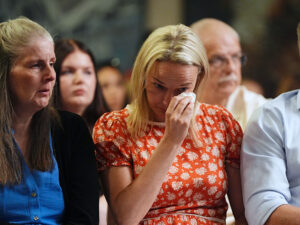
It has been called the biggest childbirth scandal in NHS history.
Over 13 years, hundreds of mothers were potentially harmed by the poor care they received at Nottingham University Hospitals NHS Trust (NUH), according to a report by senior midwife Donna Ockenden.
Six mothers and 31 newborns died after significant or major failings in care, while dozens more experienced potentially avoidable massive obstetric haemorrhages and fourth-degree perineal tears, her 382-page report said.
Based on evidence from 2500 families and 800 staffers, the review identified “cruel” treatment of both patients and staff and repeated failures to heed warnings or feedback between 2012 and 2025.
The report devoted 28 pages to a signature case: Sarah Hawkins, 33, a physiotherapist employed at NUH, whose daughter, Harriet, died during labour in 2016.
Ms Ockenden said it encapsulated the clinical failures that were repeated over years.
Sarah Hawkins was correctly identified as low risk at her initial booking and managed on the midwifery-led pathway.
She was a non-smoker, with a BMI of 19.3kg/m², whose main medical history was a previous miscarriage at eight weeks’ gestation in 2014.
A routine appointment documented a cephalic presentation and an occipital–posterior position.
At 40 weeks and two days of gestation, she attended a pre-booked appointment after a night of contractions and after experiencing a show, where it was recorded that her contractions had reached two every 10 minutes, lasting about 30-40 seconds.
A membrane sweep was performed and the fetal heart was heard.
She was discharged but returned about nine hours later, reporting three painful contractions within 10 minutes.
She was told these were not frequent enough for admission.
The next day, she and her husband, Jack, called Nottingham’s Queen’s Medical Centre (QMC) hospital, reporting that Ms Hawkins had not slept and that she had been contracting without a break every three minutes.
Asked if baby Harriet was moving normally, she responded: “I’m not sure because I’m in so much pain. I can’t tell.”
A midwife said this was normal in latent labour and that she should take codeine, have a bath, sleep and eat jelly babies for energy.
Ms Hawkins called again the next day at 3.27pm and then the day after at 14 minutes past midnight. After the latest call, staff recorded PV bleeding, which Ms Hawkins did not recall mentioning.
“In the review team’s collective experience, it has the mark of a record made in order to be able to defend a decision to invite a woman in if challenged by colleagues,” Ms Ockenden said.
After this call — her eighth contact with QMC — Ms Hawkins was invited in.
A vaginal examination showed she was 3cm dilated and fully effaced, the membranes were bulging and the presenting part was 1cm above the ischial spines. Her contractions were three every 10 minutes, lasting 50-60 seconds.
“From this vaginal examination and contraction strength and frequency, Sarah should have been considered to be in labour,” the report said.
Instead, she received analgesia and was discharged home without obstetric review.
One member of staff later told the inquiry that, in similar circumstances, it was effectively normal practice to “try and, I would really say, coerce them into going home”.
“There was a lot of pressure to make women in the latent phase normal, a lot of pressure if you were doing a vaginal examination to make her 3cm.”
At 1.48pm on 16 April, Ms Hawkins called QMC again and asked to reattend as she could no longer tell if Harriet was moving, only to be told, “It doesn’t work like that.”
She called again at 3.21pm and then at 2.18am the next morning, when a midwife offered to admit her, adding that Ms Hawkins could stay home a while longer.
Ms Hawkins said the early morning call was “the worst phone call of my life”.
“I remember crying down the phone just asking for help.
“That call is etched into my brain and nightmares for life.”
With her feeling emotionally unable to face another phone call to QMC, her husband called a few minutes later. He was advised to attend another unit, Sanctuary Birth Centre, at a different hospital.
Sarah Hawkins arrived at 4.16am with a visible bag of membranes at the introitus.
The report said staff members were “inappropriately jovial”. After someone asked her, “Is it still hanging out of you?”, Ms Hawkins started crying.
Fetal movements were recorded as felt by Ms Hawkins at 4.45am. Ms Hawkins said she did not recall fetal movements.
Similarly, fetal heartbeat was recorded, but the Hawkins both insisted a fetal heartbeat was never found during the admission.
A vaginal examination at 4.50am found the cervix 9cm dilated, at which point Ms Hawkins was told she had arrived too late for pain relief and her only birth option was a waterbirth.
Her membranes were ruptured and liquor was clear.
At 5am, a new staff member noticed a Bandl’s ring across Ms Hawkins’ abdomen.
An ultrasound attempt at 5.19am was abandoned because of urinary retention.
Ms Hawkins said another staffer had then said to her, “Why didn’t you tell me you weren’t weeing?” And, “You’re meant to be a physio, aren’t you?”
Once the catheter was passed and the scan completed, at around 5.35am, Harriet was pronounced dead.
“I’m sorry your baby’s dead,” a staff member told the parents before leaving the room.
About 20 minutes later, Ms Hawkins was moved into a room on the labour ward at 5.55am, where she requested an epidural, which was not sited until 9.20am because of a long wait for results of routine blood for intrauterine fetal death.
A vaginal examination performed at around 7.30am showed that the cervix was fully dilated, with meconium-stained liquor draining.
Syntocinon was finally started at 11am. The report said it was unclear whether a consultant had arrived at 10.50am or later, during delivery, but either was unacceptable.
Harriet was delivered stillborn at 2.48pm, weighing 3.08kg.
She likely died within the 24 hours before Ms Hawkins’ final admission or from a sudden hypoxic event at the moment her membranes ruptured, the report concluded.
This, the report said, was a result of staff normalising a six-day latent phase without a break in contractions and dismissing her pleas for help.
It said the failures did not end with Harriet’s death.
The Hawkins family were initially told an internal investigation had found that Harriet had died from infection, that no problems with care had been identified and that her death was unavoidable.
Reviewers later found those conclusions were unsupported by the evidence.
A subsequent external review, while identifying some concerns about the clinical care, reached the same final conclusions, while a local-level review made recommendations for organisational change only.
Eventually, NHS officials ordered a reinvestigation, which concluded that Harriet’s death had, in fact, been preventable.
“This investigation concluded that Harriet died from a sudden hypoxic event when she was already susceptible due to prolonged dysfunctional labour and early signs of infection,” the report said.
“The investigation found multiple missed opportunities for intervention and appropriate monitoring.
“Its assessment was that, if these measures and normal safety interventions had been undertaken and monitoring had occurred as appropriate, then labour would have been shortened and therefore the intrauterine, intrapartum fetal death of Harriet would not have occurred.”
The trust apologised in December 2017.
The Ockenden report added that, after the apology, Mr Hawkins had rung the trust in distress and the call was secretly recorded and played to maternity managers during a meeting.
The family did not learn this had occurred until 2024.
Failures to monitor babies during labour, properly interpret fetal heart traces, escalate patients and involve senior doctors early were repeated themes at NUH, the report said.
Poor governance meant similar mistakes occurred repeatedly, and bullying was widespread, it said.
Although the report acknowledged there were examples of compassionate care, these were outweighed by multiple examples of cruel treatment of women.
Some deceased babies were put in labour ward refrigerators for days because of poor mortuary arrangements.
One early-gestation baby was accidentally disposed of as clinical waste following a post-mortem examination.
Families whose babies had died decades ago said they had never been able to identify where their children had been buried.
In the case of baby Kouper Needham, who died after staff repeatedly dismissed his parents’ concerns about poor feeding and his colour, post-mortem photographs were mistakenly mailed to the family home.
The report said trust leaders had been aware of many of the issues since at least 2012.
Multiple external reviews between 2015 and 2022 raised similar concerns about bullying, governance and patient safety, without prompting any change.
“The families of Nottingham have shown extraordinary courage, dignity and determination,” the Ockenden report concluded.
“Their voices must now become the catalyst for lasting national change.”
For further context, maternal deaths in the UK have risen by around 20% over the past decade.
The Ockenden report is the fourth recent major review into maternity failures at an NHS trust.
More information: Ockenden report; 24 Jun 2026.