Delivering quadruplets from overseas IVF: ‘I was worried we would find an extra baby’
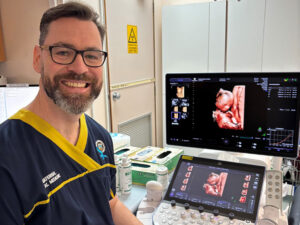
As consultant obstetrician Dr Scott White watched the caesarean surgery to deliver quadruplets, he had one pressing thought — just how many babies would emerge?
“The thing that I was most worried about was them finding an extra baby or only finding three,” he tells AusDoc.
“We actually did get set up in case there was an extra baby, a fifth baby, that we hadn’t been able to see.
“The best thing that I saw was when [theatre staff] turned around and held up four fingers and nothing else.”
The quadruplets, born on 28 April, were Dr White’s third set in 20 years and only the 15th set ever in WA.
His uncertainty had stemmed from the fact that their parents, Kalgoorlie-based Belinda and Emmanuel Lotsu, had undergone IVF in Ghana — and did not have a scan in Australia until 20 weeks’ gestation.
After that scan suggested triplets, Ms Lotsu’s care was transferred to King Edward Memorial Hospital in Perth, where Dr White works as a specialist obstetrician.
A scan at the hospital at 23 weeks revealed a fourth baby. But even then, the team could not be completely certain there was not another baby hidden among the tangle.
“In early pregnancy, they’re pretty easy because you can see all of the babies at the same time,” Dr White explains.
“But once you get past about 15, 18 weeks, then there is a baby everywhere.”
It was also not possible to confirm how many placentas and amniotic sacs there were — a key factor in managing multiple pregnancies.
“We had to manage them as if they did share placentas, in which case, we need to be much more conservative about our management and deliver them a bit earlier and monitor them a bit more closely,” Dr White says.
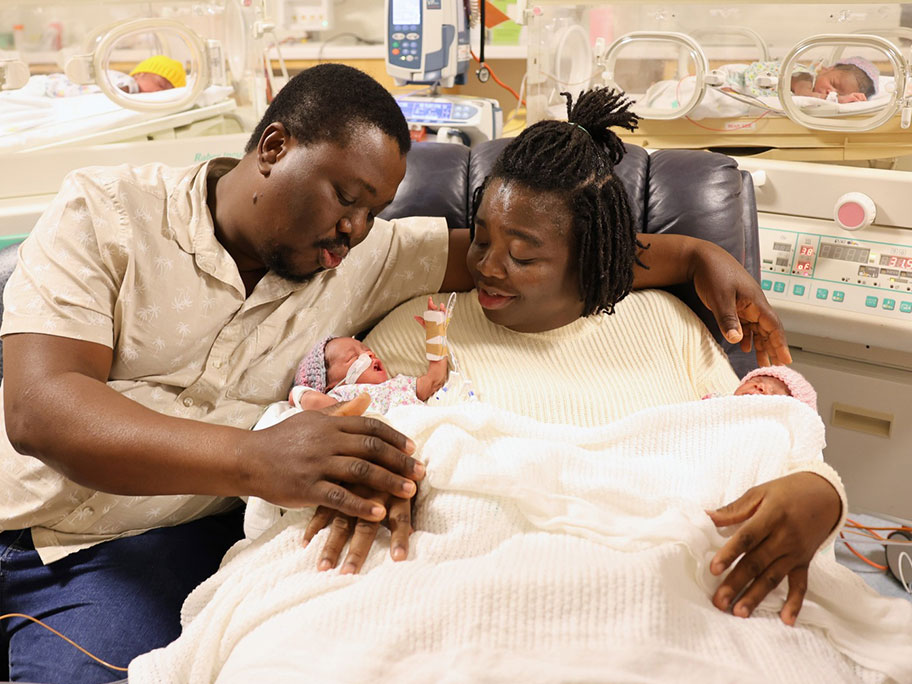
The three girls and one boy — Amy, Amana, Amber and Amon — were delivered at 32 weeks’ gestation by a team of around 25 doctors, midwives, nurses and anaesthetists.
The timing was a calculated decision.
From about 30 weeks, Dr White says the team became increasingly worried about the difficulty of monitoring the babies and the high risk of spontaneous preterm labour.
Ms Lotsu had also had previous surgery on her uterus, and Dr White was concerned that if she went into labour, she could experience a catastrophic uterine rupture.
There was also the risk that if she presented after hours, the required clinical staff may not have been available.
“It was an enormous thing to put all the right people in the right place at the right time as it was a planned procedure,” he says.
“And as is always the way, it was the Tuesday after a long weekend.”
Other risks included clots and infection.
Another complication was that the couple were not Medicare-eligible when they first presented.
Their Medicare approval came through only a week or two before the delivery.
“If you land a 28-weeker in the nursery, it’ll cost you $200,000 before they get out the door. And if you do it four times, that’s pretty scary,” Dr White says.
“We can’t turn them away. We’re going to have to look after them and provide care and so we’re going to incur these costs either way.
“And then do you chase someone for $800,000 when you know they’ve got no capacity to pay it, which eventually means they leave the country and that’s not really in anyone’s interest?
“These are lovely people, you know, who are providing really important contributions to the community,” he adds. “Her husband works in the mines in some sort of skilled trade, so they’re bringing a lot to our country.”
The quads were the first set in WA since 2020, but Dr White says there is a possibility doctors will see more such cases because of “reproductive tourism”, where prospective parents travel to countries where IVF legislation is less stringent than in Australia.
“We certainly do see people come back from overseas with some pretty crazy stories about how many embryos they’ve put in,” he says.
He suspects more than two embryos were transferred in the Lotsus’ case — possibly five or six — although he cannot know for certain.
“In Australia, you can never put in more than two,” he says.
He adds that Australia has one of the world’s leading rates of single embryo transfer and, as a result, a relatively low rate of IVF-related multiple pregnancies.
Dr White says he has even occasionally seen patients in their 60s who have gone overseas for IVF.
Provided they are fit and well beforehand, they tend to have reasonable pregnancy outcomes, given they are typically implanted with embryos from younger women, he says.
The concern, he says, is patients whose health issues — such as hypertension, poorly controlled diabetes, overweight or underlying medical conditions — are not addressed before IVF.
“Some of them [overseas clinics] are really very good and world-leading and they provide good quality care, but some of them are a bit more dodgy,” he says.
“Their primary goal is to get somebody pregnant and as soon as they’re pregnant, then they’ve achieved what they were looking for, and the longer-term outcomes of those pregnancies really aren’t what they’re interested in.
“So people who aren’t particularly suitable for pregnancy are not being optimised before they get pregnant — they come back with pregnancies that are riskier than they should have been.”
Then there are the ethical concerns — especially around egg donation.
“It’s absolutely outrageous that there are people living on the poverty line who will donate,” he says.
“They’re not really donating their eggs, they’re selling their eggs because that’s their only means of supporting themselves.
“You’ll see people in the US, the richest country in the world, who sell their eggs to put themselves through university and things like that.”
While Australia is world-leading in legislation around reproductive technology, encompassing both medical and ethical outcomes, it still has “a way to go”, according to Dr White.
“For example, in WA, gay couples and single men still can’t access reproductive treatment, whereas single women and same-sex female couples can, so there’s some significant inequities that need to be addressed.
“But on a world scale, we’re certainly doing a lot better than some places.”
Read more: Rising from its knees: The story of an O&G unit’s remarkable revival