‘Doctors fear losing what they love’: Dr Tasha Port’s suicide shows medicine’s culture of silence lingers

Dr Tasha Port was preparing to submit her application for the paediatrician training program when she took her own life in June 2020.
Medicine had been her passion since high school, and her graduation ceremony in Queensland three years earlier was, as you expect, special.
“Tasha was very happy that she had made it — she was going to be a doctor,” says her mother, Indrani Tharmanason.
She loved her work, but through her life she had struggled with periods of depression. It meant the stress, long hours, night shifts and career uncertainty took a toll.
As a result Dr Port began to lose weight and talk less, becoming increasingly introverted.
So when she decided to move back to Victoria, the hope was that being closer to her parents and two brothers would provide a safety blanket when the black clouds loomed.
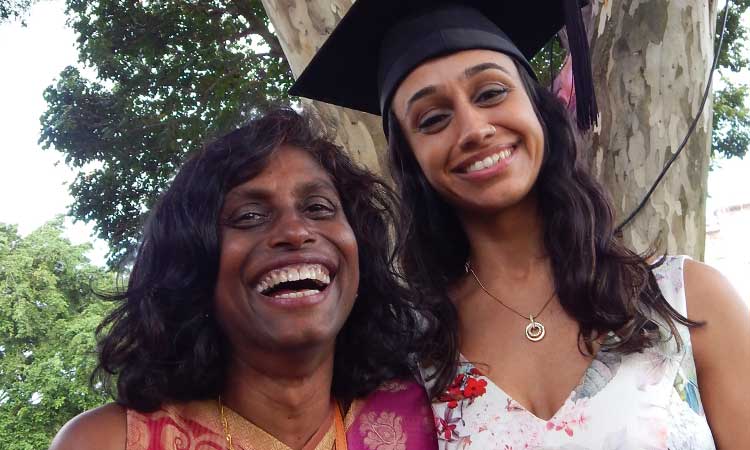
Ms Tharmanason with her daughter Dr Tasha Port at her graduation.
She ended up taking a role in the paediatrics ward at Mildura Hospital. But the talk among the junior doctors was that cracking into the paediatrician training program was going to be tough.
And so it proved.
Her mother says it became hard for her daughter to forge friendships and retain social contact outside of work.
“Tasha’s time off didn’t necessarily match other people’s time off. Things came up suddenly, making it difficult to make plans for socialising.
“Transfers from ward to ward, sometimes from hospital to hospital, all fed into that social isolation junior doctors can face.”
As happens so often, none of her colleagues knew about her struggles until they were told she had died.
Ms Tharmanason says her daughter feared that talking about her mental health would affect her career prospects.
Back in 2017, the tragedy of doctor suicides broke into the national conversation when the family of Dr Chloe Abbott — a fourth-year trainee doctor who also took her life — spoke of the similar pressures she confronted including that desperate pain of emotional isolation.

Dr Tasha Port.
In the aftermath, mandatory reporting laws were changed to encourage doctors to seek mental health care without fear of being processed by the regulatory regime.
But Ms Tharmanason says too many doctors still keep their experiences of depression and anxiety a secret from those around them.
“Tasha was absolutely not going to let people know in the work environment that she had struggles.
“[She thought] there would be a black mark on her. She thought she wouldn’t get into the paediatrics training program.”
She adds: “For doctors, the fear of seeking help is the fear of losing the thing that they love.”
Ms Tharmanason is suggesting a mandatory buddy or supervisor set-up for all junior doctors.
“They already have supervisors for whenever they’re in the hospital for the technical stuff, but they need someone they can talk to about how they’re feeling,” she says.
“Where junior doctors are concerned, right from the day they get into the hospital, there needs to be someone working with them.
“If the goals are not realistic, someone can say, ‘There are other options … If you don’t do this sort of medicine, you are not a failure.’”
She says speaking about her daughter’s death has been a difficult decision but that she hopes it will help change the culture.
“I can just say that, every time a doctor dies, it has a huge impact on a very big group of people.”
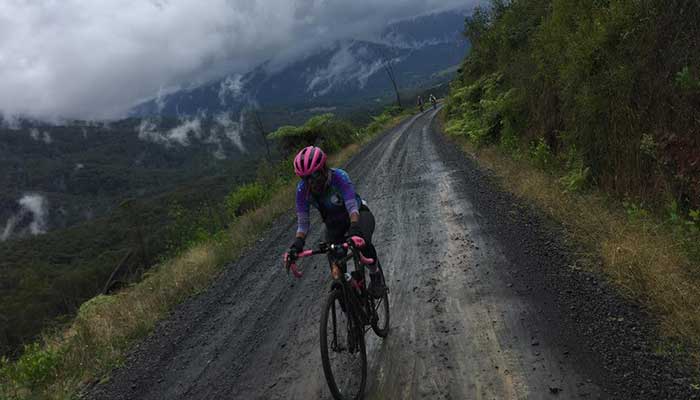
Indrani Tharmanason cycles at a Travelling with Tash fundraising event.
| Ms Tharmanason and her husband have gone on to establish the Travelling with Tash scholarship to financially support medical students at the University of Melbourne. It was awarded for the first time in May 2023. They have also established the Travelling with Tash fund through the Melbourne Lord Mayor’s Charitable Foundation, which distributes the donations annually to a nominated charity or social program. In 2022, the donations went to supporting homeless people in Melbourne. And together with friends, colleagues and classmates of Dr Port, Ms Tharmanason and her husband raise money for Beyond Blue through bike rides and hikes. A cycling trek this month raised over $30,000 for Beyond Blue. “Through the fundraising, I was able to write a lot of blogs about Tasha and stories I wanted to tell about her,” Ms Tharmanason says. “It was very helpful for me to do that because I remembered all the good bits.” She says her daughter had always been independent and enterprising, going back to her first solo international trip when she was just 12. Her first hospital placement as a medical student was in Brunei, Malaysia, where she travelled to a rural clinic via helicopter. “I remember all that her cousins were thinking was, ‘God, you could have chosen a nice and cozy place,'” Ms Tharmanason says. “But she was so excited.” She also remembers Tasha getting her driving licence as soon as she could “so she could proudly drive all her friends around in a seven-seater Honda Odyssey”. “While there was tough darkness, there was so much that she achieved,” Ms Tharmanason says. “She always had a smile on her face. “She laughed a lot.” |
If this news story has raised issues for you or you are concerned about someone you know, you can call the following support services 24 hours a day, seven days a week:
State- and territory-based doctors’ health services:
- ACT: 1300 374 377
- NSW: 02 9437 6552
- NT: 08 8366 0250
- Queensland: 07 3833 4352
- SA: 08 8366 0250
- Tasmania: 1300 374 377
- Victoria: 03 9280 8712
- WA: 08 9321 3098
Mental Health Support Line (telepsychology):
- 1300 374 377 (Drs4Drs)
Other services:
- Lifeline: 13 11 14
- Beyond Blue: 1300 22 4636
- Suicide Call Back Service: 1300 659 467