Dr John Dique: the ‘uncompromising racist’ who made Australia’s first dialysis machine

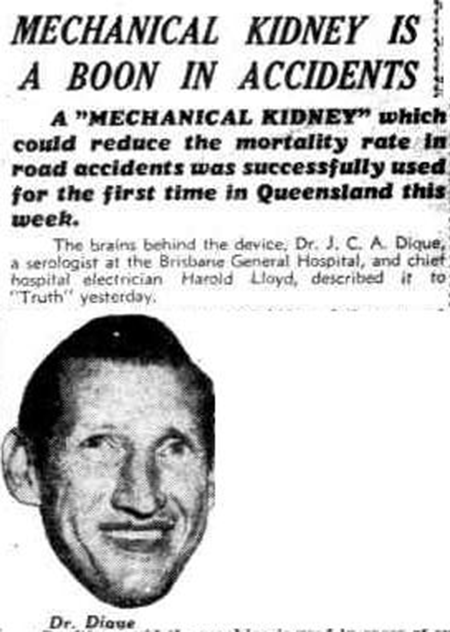
MECHANICAL KIDNEY IS A BOON IN ACCIDENTS
That was the 1954 headline in the newspaper Truth that announced the start of dialysis in Australia.
This ‘mechanical kidney’ was a 1.3-metre rotating drum wrapped in an extended semi-permeable tube of cellophane and submerged in a 150L plastic bathtub full of dialysis fluid.
The brains behind it were Brisbane General Hospital serologist Dr John Charles Dique and the hospital’s chief electrician, Harold Lloyd.
In a Medical Journal of Australia case report, Dr Dique described using the ‘mechanical kidney’ to save a 36-year-old woman who had delivered a stillborn, macerated fetus 12 days earlier.
The partly retained placenta became infected with Clostridium perfringens.
The patient’s pre-dialysis serum urea level was reportedly 440mg/dL.
More than six hours of dialysis, during which the patient also received IV calcium gluconate, brought this down to 196mg/dL.
Total blood flow through the machine measured 46L.
Dr Dique based his mechanical kidney on the work of Dutch pioneer Professor Willem Kolff — who developed the first dialysis machine in secret in Nazi-occupied Netherlands and actively helped hide people from deportation to labour camps.
Dr Dique made important modifications to Professor Kolff’s design.
Professor Kolff’s design struggled to control ultrafiltration, but Dr Dique’s design included two 500mL flasks through which blood flowed. Two attendants repeatedly emptied and refilled the flasks to maintain equilibrium.
Dr Dique treated nine patients with acute renal impairment with his first machine — four survived.
Following Professor Nils Alwalls’ work in Sweden, Dr Dique made a second, easier-to-use and more efficient machine, though with limitations related to blood leak detection and urea removal.
Between 1957 and 1963, he treated eleven more patients, with five surviving.
As the decades passed, Dr Dique’s mechanical kidney became overshadowed by more efficient commercial dialysis machines and his growing reputation as, in the words of the Australian National University’s Australian Dictionary of Biography, “an uncompromising racist”.
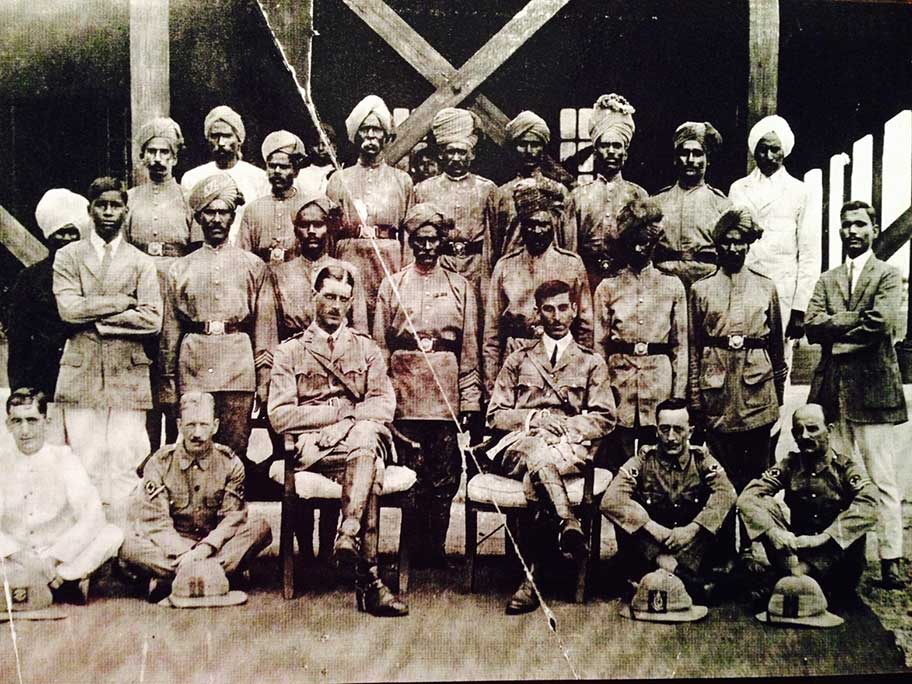
Dr Dique was born in 1915 in what is now Myanmar but always considered himself British, despite never setting foot in Britain.
He went to boarding school in the Himalayas, completed a medical degree at the University of Madras in India and according to one historian learnt at least three Indian languages: Hindi, Urdu and Tamil.
Amid the violence of the 1947 partition of India, Dr Dique, his wife and their five children fled to Australia.
By 1975, Dr Dique was president of the Queensland Immigration Control Association.
A letter attributed to him, calling for new members, makes clear the association’s nature.
“Are you aware that a system of genocide is being carried out against the white people of Australia, Canada, the UK and the USA?” it said.
It went on to blame “excessive taxation … massive donations of foreign aid to countries which give nothing of a material nature in return … admission as migrants of people who can neither be integrated nor assimilated … [and] a falling marriage and birth rate”.
It continued: “Meanwhile large areas of Australia are comparatively unexplored and the Aborigines, who should be in process of being changed into a settled community from a nomadic one, so as to fit them for changing conditions, remain in many cases as they have existed for centuries.”
Dr Dique also joined the far-right group The Australian League of Rights, which even today sells $5 copies of Dr Dique’s booklet Immigration: The Quiet Invasion, alongside anti-vaccine and anti-Semitic books.
He claimed that rank-and-file members of the National Party agreed with his views on race and immigration but did not speak up for fear “of being called racist”.
The Australian League of Rights has a history of trying to conduct a shadow takeover of The National Party.
Dr Dique died on 18 January 1995 in Brisbane.
His Australian Dictionary of Biography citation, published around 25 years later, concluded:
“Dr Dique was a devout Catholic. In his spare time, he cultivated his garden … played the violin, sang, practised recreational carpentry, and enjoyed the company of his children, grandchildren and great grandchildren.
“His wife survived him, as did their three daughters and three of their four sons.
“He left both a rich professional legacy and a reputation as an uncompromising racist.”
Read more: The dark side of the maverick genius behind a medical revolution