GP turned forensic investigator: ‘If you own every trauma you see, you would drown under the weight’
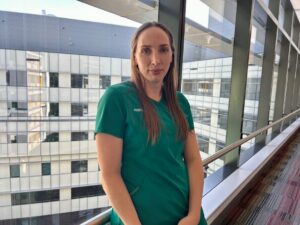
For a discipline underpinned by scientific rigour and exactitude, Dr Rachel Marr acknowledges that sometimes the findings she makes are clouded by uncertainties.
The GP is one of only two doctors to complete the Royal College of Pathologists of Australasia’s (RCPA) fellowship training program in clinical forensic medicine since it was established in 2015.
Her work involves examining victims of sexual assault and family violence, assessing people accused of crimes and giving expert opinions about how injuries may have occurred.
Speaking of the TV shows that inspired her future career — particularly the US docudrama The New Detectives — she says, “I loved that science was being used in a legal way to assist with justice.”
But she has learned to get comfortable with unanswered questions in forensic medicine.
“Sometimes I will give an opinion where I have to say, ‘There are many ways that this injury could have occurred and I can’t tell you which specific one it was.’
“Uncertainty shows up so often.”
A love of science and communication led Dr Marr to study medicine at Melbourne’s Monash University.
After graduation, she initially pursued physician training, but changed direction just before the physician exam, after becoming concerned about the shortage of specialist positions.
“There was a huge bottleneck at the time and there were a lot of people qualifying as physicians who weren’t getting jobs,” she says.
“I thought, ‘I don’t want to be busting my butt for this and not get a job.’”
It was during her GP training that she took up a six-month rotation as a clinical forensic registrar at the Victorian Institute of Forensic Medicine.
She remained there as a casual doctor and, shortly after completing her GP fellowship in 2017, successfully applied for a permanent part-time forensic medicine role.
For the next five years, she divided her time between general practice and forensic medicine.
“I loved that when I didn’t like one job, I would go to the other and enjoy that, and vice versa,” she says.
The two disciplines complemented each other, she says, not least in the confidence she gained through managing her patients whose lives were being torn apart by family and sexual violence.
And the broad clinical knowledge and creative thinking required in general practice helped her avoid drawing overly simplistic conclusions from forensic evidence.
“In forensic medicine, you can’t be black and white,” she says.
“There is a lot of nuance, and care needs to be taken not to mislead the court and to make sure that your evidence is reliable.”
Clinical forensic medicine has a long history, nourished in the public mind by Sherlock Holmes fictions and his remarkable deductions rooted in his extraordinary knowledge of bloodstains, the residues of poisons, footprints, forensic handwriting analysis, tobacco ash varieties and head shapes.
But when it comes to specialist recognition, the discipline remains somewhat marginal even today.
The pathology college set up its faculty of clinical forensic medicine in 2014, with doctors already working in the field awarded the postnominals through a grandfathering arrangement.
The formal fellowship training pathway was rolled out in 2015. However, there has been little uptake since, and clinical forensic medicine is still not recognised as a standalone specialty by the Australian Medical Council.
Partly this is a result of the limited number of full-scope forensic services in Australia.
“Many jurisdictions only have a sexual assault service, where clinicians who might be doctors or nurses provide forensic examinations after a sexual assault,” Dr Marr says.
Dr Marr relocated from Victoria to Queensland in 2023 for the training — and was awarded fellowship last month.
Her fellowship involved placements in child protection and death investigation, training in toxicology, research projects, including a paper on hyoid fractures in strangulation and sex play, and about 200 workplace-based assessments.
It also brought her face-to-face with cases she found difficult to separate from her own life — particularly her life as a parent.
“Seeing autopsies of babies and toddlers when I have children of my own was challenging,” she says.
“And seeing child protection cases and hearing about a five-year-old child who is being physically abused when I’ve got my own five-year-old at home — you’ve got to be so careful to hold a screen in your mind.
“There is so much empathy there, but I had to emotionally distance myself a little and try to treat it as an academic exercise. Otherwise, I would go home and cry.”
Dr Marr is now working full-time as a senior forensic medical officer at the Gold Coast Health Forensic Medicine Unit — the only accredited training site in Queensland, one of the few Australia-wide.
Until recently, it was run by Dr Cathy Lincoln, a pioneer in the field who was one of the founding fellows of the faculty of clinical forensic medicine and helped shape the integration of clinical forensic medicine into mainstream hospital emergency care.
Dr Marr’s work also involves examining living victims of crime, with her team providing expert opinions on the possible mechanisms and medical consequences of injuries.
The scientific questions may be complex, but the emotional uncertainty can be just as difficult.
“We don’t always get closure,” she says.
“That happens a lot with family violence and sexual violence because many of those cases unfortunately never make it to court.
“Sometimes we’ll see someone and then we never hear about the case again. We have no way of knowing what has happened, or not happened, from a legal point of view.”
It can be easier to let go when she knows a victim will receive follow-up care and counselling.
Among the cases that have stayed with her was one where she was asked to examine a man accused of pouring petrol over his wife and setting her alight.
Her role was to document his burn injuries.
“There were circumstances that made me realise how marginalised that woman was and how little support she had,” Dr Marr says.
“Essentially, I felt that as a community we had not kept her safe.
“That really affected me.”
She says she manages the emotional burden by talking to colleagues and exercising, particularly running.
She also maintains a deliberate separation between caring for the person in front of her and providing impartial evidence to a court.
“When I’m with the patient, I’m providing them with the best trauma-informed care that I can,” she says.
“I then have to turn that off and remember that I have to be neutral for court.
“I hope that doesn’t sound callous, but I think if you own every trauma that you see, you would drown under the weight of it.”
This year, Dr Marr returned to occasional general practice sessions because she “missed fixing things”.
“In forensic medicine, we help with the law and we help justice sometimes, when we can,” she says.
“But I missed meeting a person, talking to them and fixing something.
“Being able to do both has been so good for keeping that balance for me.”
Read more: The amazing career of medicine’s Guardian of the Dead
If you or someone you know is experiencing domestic, family or sexual violence, support is available. In an emergency, call triple zero:
- 1800RESPECT: 1800 737 732
- 13YARN: 13 92 76
- Kids Helpline: 1800 55 1800
- Elder Abuse Help Line: 1300 651 192
- Rainbow Sexual, Domestic and Family Violence Helpline: 1800 497 212
- DVConnect Womensline: 1800 811 811
- DVConnect Mensline: 1800 600 636
- MensLine Australia: 1300 789 978
- Men’s Referral Service: 1300 766 491
- Lifeline: 13 11 14
State and territory crisis services:
- ACT: 02 6280 0900
- NSW: 1800 656 463
- NT
- Queensland: 1800 811 811
- SA: 1800 800 098
- Tasmania
- Victoria: 1800 015 188
- WA: 1800 007 339
Clinical resources: