‘I make spare parts for people — a nose, ear or eye’: The face makers moulding new lives for cancer patients
Sophie Fleming is a clinical anaplastologist.
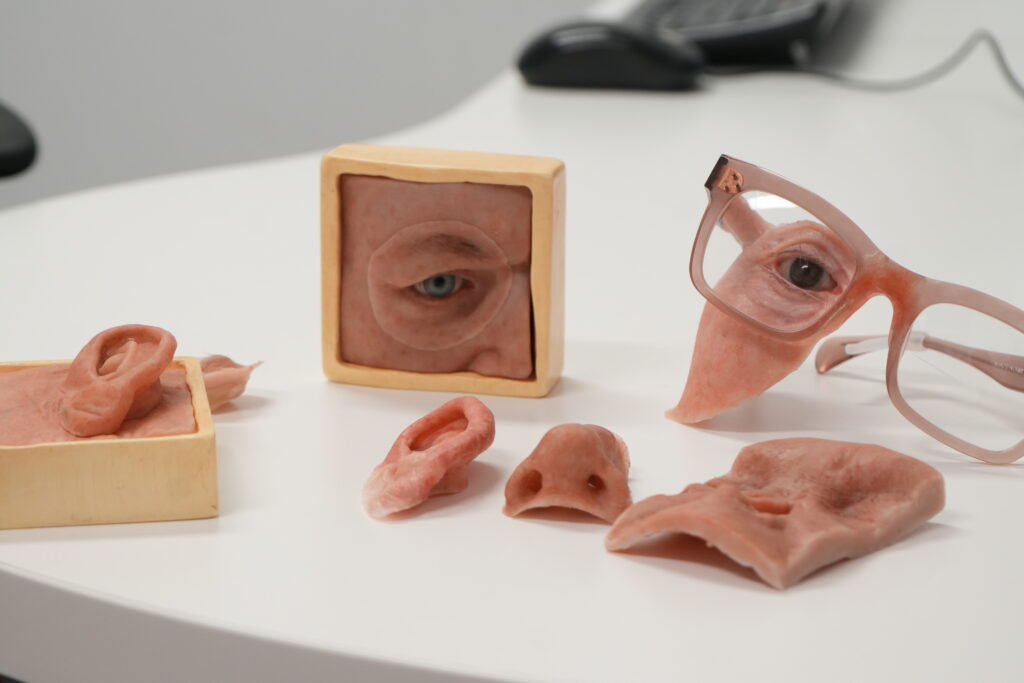
She is sitting with a collection of her “spare parts” laid out on a desk.
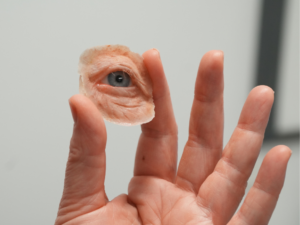
An orbital prosthesis complete with wrinkled eyelids and thin grey eyelashes. A pair of spectacles with a prosthetic eye socket suspended behind the right lens.
There are also silicone ears with faint freckles and a flush of redness on the helix.
Their disembodied existence gives you a sense of shock. Some are encased in a display box — separated from the people and faces to which they belong.
When AusDoc visits, Ms Fleming is holding her monthly clinic at Chris O’Brien Lifehouse in Sydney, a leading hospital for cancer patients.
The lives of the majority of the patients she sees have been ravaged by head and neck cancer, and they will discuss with Ms Fleming how they would like to appear, the colour shades of their eyes, the tones of their skin.
Some will embrace their prosthesis as a way of expressing their individuality, with unique colours or intricate designs. But although Ms Fleming once fashioned a bright pink prosthetic hand and colourful fingers for a guitar player, most just want realism.
“Generally, the people I see are the ones that want that sense of normalcy returned,” she says.
After the initial assessment, usually three or four more consults take place.
“We might do a 3D scan of them, especially if it’s an ear, or we’ll take a physical impression of them.
“To create the shape of the prosthesis, it will be sculpted by hand out of wax just by looking at photographs. If we’re lucky, we might have a copy of [their features] before they’ve had their surgery.”
By the third consult, the patient will try on the wax model.
“For eye or orbital prostheses, we might do that multiple times to make sure we get the shape right. It’s quite a laborious process that one,” Ms Fleming says.
The prosthesis itself is then made with silicone and the necessary pigments to match the skin.
“At the final fitting, we’ll be hand-painting all those detail layers [while the patient wears the prosthesis] so that it blends perfectly.”
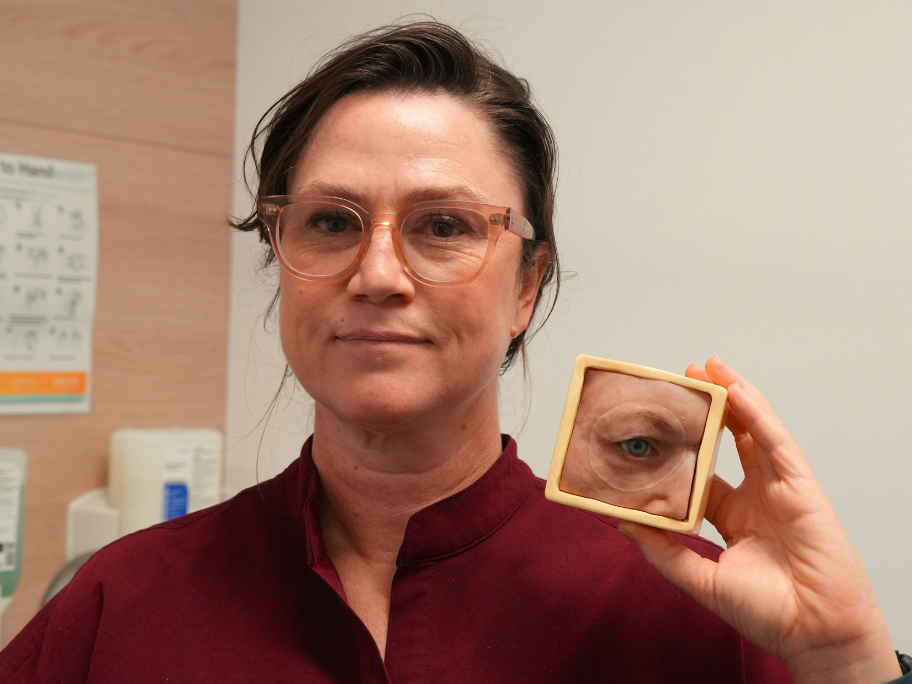
Ms Fleming can also change the prosthesis as the patient ages — adding more wrinkles or altering the size.
How it is secured depends on the patient’s preferences, dexterity and anatomy. Spectacle-retained prostheses are easy to remove, while adhesive-retained prostheses require a suitable flat surface, and implant-retained prostheses — which snap magnetically into place — require sufficient healthy bone.
The creation of these precious custom objects can cost anywhere between $3000 and $12,000.
“I think everyone who works with me in my practice has all come from an arts background and then added the science to it afterwards,” Ms Fleming tells AusDoc.
“That’s just because it’s such an essential part of it — you can make a prosthesis, but if you can’t get it to look realistic, then it’s not functional.”
More than 20 years ago, Ms Fleming transitioned to anaplastology. At the time, she was working in film and television special effects and prosthetics.
She ended up earning a master of science in maxillofacial prosthetic rehabilitation from King’s College London.
But a clinical anaplastologist is a rare profession in Australia. Unlike in the UK, there is no national education pathway or accreditation body.
Ms Fleming is the first to admit that her services can be difficult to access.
In 2025, the Federal Government commissioned KPMG to review access to cancer prostheses in Australia, which released its final report in May this year.
It found patients with head and neck cancer were falling through funding gaps because prostheses designed primarily to provide a lifelike representation of a missing body part are considered ‘cosmetic’ rather than ‘functional’.
As such, they are excluded from the National Disability Insurance Scheme (NDIS) product list and the government’s list of devices which it mandates private insurers cover.
It is a cruel definition, given what it has meant.
For Tracey David, living without a prosthesis made her feel like a “freak”.
She lost her nose in 2024 as part of her treatment to remove a malignant tumour from her face.
Speaking at an event at Parliament House in Canberra in August, she recalled that she often worried about flies and bugs in the summer because of the hole where her nose was.
“My grandchildren couldn’t look at me. I mean, I had this thing on my face. [They would say], ‘Nanny, you poor thing,'” Ms David said at the event, which was hosted by Head and Neck Cancer Australia (HANCA) and the co-chairs of the Parliamentary Friends of Cancer Care and Cure group.
Eventually, Ms David was able to fund a prosthetic nose through a one-off payment from a charity attached to St Vincent’s Hospital Sydney. This will not cover future replacements, which can be necessary every 1-5 years for facial prostheses.
She says that receiving a prosthesis has had an “amazing” impact.
“I’m a woman; you need dignity, you need to go out and see people,” she said.
“I have a husband who married me, and to look at that [her face without a prosthesis] and then to this.”
Ms Fleming, director of Prosthetic Art Technology, divides her time between her everyday clinic outside Ballina in northern NSW as well as clinics at Chris O’Brien Lifehouse, a Brisbane prosthodontist’s practice and a Newcastle ENT in NSW.
Many patients travel long distances to access her services.
“In Australia, I can count on two hands the amount of people that do what I do,” she says.
Workforce shortages are only part of the access problem. These prostheses transform people’s lives, but funding restrictions mean many are forced to go without.
“A prosthetic eye doesn’t make a child see again, so it doesn’t matter according to the NDIS, but it does make them look like everyone else!” one clinician told KPMG.
“Families are saying, ‘I don’t need funding for occupational therapy … I just need an eye so that my child can go to the playground without being called a monster.’”
Ms Fleming says they allow people to “live life on their own terms”.
Anaplastology itself emerged more than a century ago; as you would expect, as a product of the horrors of WWI, when clinicians faced an unprecedented scale of catastrophic injuries caused by mechanised warfare.
While advances in plastic surgery were often incredibly successful — New Zealand otolaryngologist Sir Harold Gillies pioneered the field — many soldiers could not have their features restored.
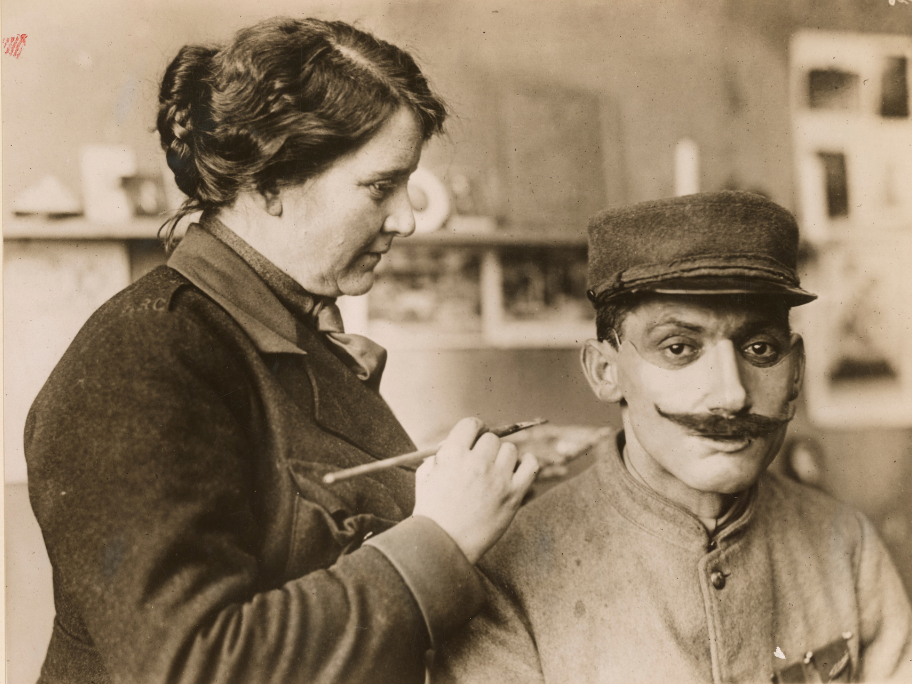
For these patients, English sculptor Francis Derwent Wood and US sculptor Anna Coleman Ladd offered their services. They made custom masks or features from thin sheets of copper, painted with enamel and detailed with human hair to resemble the patient’s pre-injury features.
Little is known about how the men who received these masks fared after the war, but Ladd apparently corresponded with some of her patients who wanted to express their gratitude.
“Thanks to you, I will have a home,” one soldier wrote to her. “The woman I love no longer finds me repulsive, as she had a right to do.”
“The letters of gratitude from the soldiers and their families hurt, they are so grateful,” Ladd wrote.
Dr Matthew Magarey is chair of HANCA’s board and a head and neck surgeon. Speaking at the Parliament House event, he said it was “difficult” to understand how patients who have endured long and brutal treatments can be left without funding to access the facial prostheses they need.
“I want to be really clear — facial prosthetics are not cosmetic.
“They’re an essential part of recovery and survivorship care for people who have gone through cancer treatment affecting their face,” who is a head and neck surgeon.
Head and neck cancer remains one of the most difficult cancers to treat, and the price of survival for some of his patients — removing parts of their face — is confronting.
“[Head and neck cancer] affects parts of our body that are most closely connected to who we are,” said Dr Magarey, who practises at Peter MacCallum Cancer Centre in Melbourne.
“It affects our face, our voice, our throat, our mouth. It affects how we eat, how we talk, how we breathe, how we smile, how we see, hear, taste, smell.
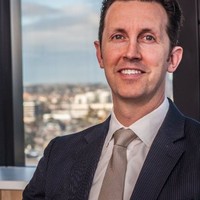
“It affects how we interact with the world.”
Referring to the funding vacuum for what remains a relatively small patient cohort, he said: “I can help cure my patients, but I need the government’s support to help my patients find the final piece of their puzzle to feel whole again.”
This year, HANCA made a pre-budget submission calling on the Federal Government to commit $25 million over four years to establish a publicly funded national reimbursement scheme.
They said the scheme would support the more than 300 Australians each year who face barriers to access facial prostheses, as well as improve national workforce development.
It was ignored.
AusDoc asked the Department of Health, Disability and Ageing why there has never been a comparable national scheme for facial prostheses and whether, in light of the KPMG report, they are considering establishing one.
We were told that the government was aware of the “important role that facial prostheses can play in recovery, quality of life and social participation”.
It is now working with states, territories and other stakeholders to “better understand” current barriers to access and opportunities for improvement.
The department added that HANCA will receive $2.6 million under the Australian Cancer Nursing and Navigation Program to provide a specialist head and neck cancer helpline to patients, including “information, support and navigation assistance”.
This is not related to their advocacy work on facial prostheses.
Back at Chris O’Brien Lifehouse, Ms Fleming says it is “an honour” to care for her patients.
“They’ve faced death and gone through that whole battle, and often by the time I see them, they’ve come through the other side.”
She says her work is often the positive experience — the “journey back”.
“It is an emotional thing, a beautiful process to be part of.”