‘I was shocked at the risks’: Dr Kate Stannage on life as a pregnant orthopaedic surgeon
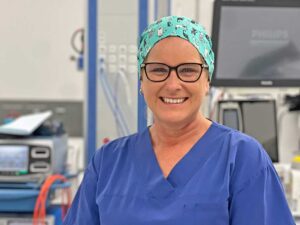
As an orthopaedic trainee, Dr Kate Stannage says she just wanted to blend in with the blokes — even through her two pregnancies.
The gender bias in orthopaedics is notorious, of course, but it still comes as a shock to discover that she was just the third female orthopaedic surgeon in WA when she secured fellowship in 2008.
As such, she is a trailblazer not only in her field but also as an advocate for the female trainees now following in her footsteps.
The consultant orthopaedic surgeon at Perth Children’s Hospital has been in the news recently following the release of Australian Orthopaedic Association (AOA) guidelines on the risks to pregnant orthopaedic surgeons.
They cover exposure to bone cement and diathermy smoke, as well as limiting exposure to cadavers and anatomical laboratories because of formaldehyde — and they address those less tangible issues like on-call demands and excessive working hours.
Dr Stannage has direct experience.
“It’s not fun having morning sickness, which is actually all-day sickness, for seven months,” she tells 6minutes.
“Standing for hours in a lead gown under hot operating lights, feeling nauseous, is a pretty unpleasant experience.
“I don’t want to be too personal about it but it was hard. There was no support. I was on call until 37 weeks and had my first child at 37-and-a-half weeks.
“I don’t think anyone was deliberately doing that to me.
“It was just that no-one thought about these things, such as the hours we were working. So we soldiered on.”
With her two children now aged almost 22 and 19, Dr Stannage said her pregnancies were during a different era. It was a time when female orthopaedic surgeons were so vanishingly rare, they could not even stick together — there simply were not enough of them.
“Our experience was more about trying to keep our heads down and justify our roles as women in surgery, as opposed to anything else,” she recalled.
“We 100% did not want to be different because we already stood out so much.”
Women accounted for just 5.4% of the surgical workforce in Australia and New Zealand in 2023. And as of June this year, the AOA had 93 female fellows — 6.5% of its membership.
But change is coming. Women account for 23% of current trainees — and in the first round of offers for next year, 26% of successful trainee applicants are female.
“The pipeline has opened, but it’s been a slow trickle,” said Dr Stannage.
Although she encourages women to pursue the specialty, she said she was shocked while working on the guidelines about the risks to their fertility.
Based on a 2024 literature review led by orthopaedic surgeon Dr Elizabeth Garcia, the guidelines reveal that 32% of surgeons have fertility issues, compared with 11% of the general population.
The pregnancy complication rate among surgeons is 35%, and 42% of female surgeons have experienced pregnancy loss.
“When we have presented this research, there’s been a complete quiet in the room. People are shocked at the stats,” said Dr Stannage, president of the AOA’s Orthopaedic Women’s Link.
While risks for pregnancy from radiation and methacrylate have been well known for some decades, she said there has been growing awareness of more “nebulous” factors such as hours worked, time on feet and shift work.
The 2024 review in the ANZ Journal of Surgery noted that working more than 40 hours a week in the second and third trimesters had the same effect on fetal growth as maternal smoking and increased the risk of preterm labour.
“These have been addressed in the pregnancy guidelines. So I think change is happening and will continue,” she said.
Dr Stannage said pregnant trainees still feel pressure to keep working at the same pace and without special allowances.
“And that is [the reason] why we thought getting these guidelines out was so important. It takes away some of the need to explain yourself all the time as a female surgeon.
“We’re hopeful that just having the guidelines will change attitudes and just enable a smoother path.”
She stressed they developed guidelines rather than strict rules because of their acknowledgment that pregnancy is not a physical affliction and that every woman experiences pregnancy differently.
“With more women coming through, hopefully it will start to become more accepted and a normal part of training that they might be pregnant and need these other adjustments,” she said.
Dr Stannage finished her training at 36, having taken two years of maternity leave to have her children. The most common question she is asked by trainees is: ‘When’s the best time to have a baby?’
“The answer is, there is no good time and there’s no bad time. You just have to make whatever time it is — work,” she tells them.
“I do try to encourage people to not put off child-bearing for surgery, because we know all the infertility risks across the general population, and having children later.
“Think of the external things, but don’t delay having children just because you want to be a surgeon.”
Read more:
More information: