‘Lie low to the wall until the bitter weather passes’: What traumatic spinal surgery taught this intern
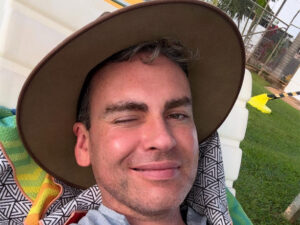
Dr Roland Bull decided to study medicine while recovering from spinal surgery in his 30s.
A writer, comedian and now an intern at Royal Darwin Hospital, he was to face yet more serious health problems before he made it.
My entry into a medical career has been a pretty wild ride. It began back in 2017 when I underwent a spinal procedure during which the surgeon operated on the wrong part of my back.
Cue corrective surgery, unexpected complications and a lengthy period of recovery. During my downtime I began to wonder what I might contribute as a doctor.
I fronted up to medical school in 2020 champing at the bit to launch into study and clinical exposure.
A couple of months later, the pandemic hit and our eager cohort was turfed online. To help soothe our frustration, a medical mentor turned close friend forwarded a passage by poet John O’Donohue beginning with the words:
This is the time to be slow.
Lie low to the wall
Until the bitter weather passes.
Try, as best you can, not to let
The wire brush of doubt
Scrape from your heart
All sense of yourself
And your hesitant light.
They’re words I kept coming back to as my medical studies progressed. I had to, because life kept throwing spanners in the works.
One morning in second year, I woke with a paralysed right foot, the result of overnight nerve root compression from a wayward piece of intervertebral disc.
The health upset was tough to balance with medical school, so I took a year off. I was apprehensive about losing pace with my classmates and self-conscious that I couldn’t just power through.
But I kept telling myself, ‘This is the time to be slow.’
In final year, during Objective Structured Clinical Examination week, I discovered a benign but nasty tumour lurking at the base of my brain, which sent my health careening off course once more.
I got over the line academically, but had to scramble to postpone internship and watch yet again as my classmates progressed their careers around me. There were more frustrated tears and deep breaths, reciting ‘This is the time to be slow.’
The problem is, medicine isn’t slow. It’s frenetic, fast-paced and high-pressure. I’ve been subject to a few instances in which life has forced me to slow down, but how do we find the right pace when our bodies and catastrophic world events don’t step in and do it for us?
Having entered a medical career later in life, I’ve long felt like a curious outsider. One of the many oddities I’ve observed among doctors is that we’re often woeful at practising what we preach.
If someone came to us with symptoms of vocational stress and burnout, we’d likely advise they take some time off work and offer a medical certificate. But when we’re experiencing those things ourselves, many of us still try to forge ahead.
A few years observing this dynamic led me to coin my own, somewhat less poetic motto: first do no harm begins with self-care.
A reminder that your capacity to care for others is impacted by the steps you take to care for yourself.
It’s hard to prioritise yourself when you’re run off your feet with an excessive patient load, but lack of regard for your personal wellbeing can have flow-on effects to the functionality of your team and the health outcomes of the people you’re looking after.
Perhaps part of the difficulty is that self-care and self-worth are intrinsically linked.
Medical careers are difficult to access, complex to navigate and accompanied by a high degree of social standing. Many of us pursue them, at least in part, to prove ourselves in some way.
Even after all my health upsets, when my self-worth is ebbing, my instinct is to work harder to try to regain a sense of value.
What I actually need is the opposite: to pause and remind myself that I’m also worthy of care. To ask what my body and mind need to feel nourished.
In practical terms, that usually means taking a day or two off and doing absolutely nothing medical. That last part can be tricky, because medicine has a way of becoming all-consuming.
A strategy I’ve found useful is to store some self-worth in a few different places.
Aim to practise medicine among other pursuits that bring you joy and make you feel valued.
They might be family, exercise, adventure and creativity. They might still be things you find challenging, so you get the double high of looking after yourself and proving yourself at the same time.
Just keep your reserves of self-worth handy and draw on them when you need a reminder that you too deserve to be cared for.
If you’re struggling, you can always come back to that beautiful passage by John O’Donohue:
If you remain generous,
Time will come good;
And you will find your feet
Again on fresh pastures of promise,
Where the air will be kind
And blushed with beginning.