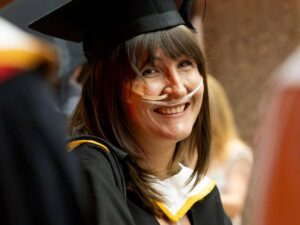
How do you practise medicine as a deafblind doctor? Meet Dr Alexandra Adams
“The first day on placement, I spoke to one of the doctors who said, ‘Imagine you are a patient — would you want a disabled doctor?’
“And they sent me home.”
This is Dr Alexandra Adams who has just shown how misinformed some people can be by becoming the UK’s first deafblind doctor.
She has low levels of colour vision — she can, for instance, make out mouth movements to lip-read. She also uses hearing aids.
Last month, she told AusDoc that she has just started her first junior doctor rotations after 10 years of study, broken up by multiple medical emergencies.
Registered deaf and blind from birth, Dr Adams was also born with several conditions which have led to recurring stints in hospital and mean that she now also carries an oxygen tank with her.
As a child, she trained to swim at the 2012 London Paralympic Games, but a series of stomach surgeries at 16 ended her hopes.
While in hospital, she did find a new dream, however.
“At that time, all I could do was observe. But I began to observe what made a good doctor and what made a not-so-good doctor.
“I met a doctor who had been a patient herself. She showed me that empathy goes a long way.”
Teachers told her pursuing medicine was pointless, but she remained stubborn.
“I knew I was going to be slightly different to everybody else, although it wasn’t on my radar that I was potentially the first deafblind doctor.”
She essentially had to discover her own techniques for practising medicine, although she also picked up techniques from the US, which has a handful of blind doctors in practice.
“It took a lot of discovering new hacks, and time in the sim lab.
“But disabled people learn how to live and have careers every day.
“People think it’s impressive that I leave the house on my own — I have to remind myself that 99% are asking questions, not malicious, just curious.”
Dr Adams received her medical degree in May and now works at a hospital in Dorset in southern England.
So how does she do her work?
Technology plays a role — she can connect her hearing aids to a wireless stethoscope via bluetooth, and her phone can scan written notes and read them to her.
Software she uses for imaging such as X-rays can detect changes in colour and opacity, and then feed that information back to her through sound.
But many solutions are not “techie”, she says.
For instance, to insert a needle in a venipuncture procedure, she sets out her equipment in her tray precisely to ensure she knows where it is.
She then palpates, finds a vein and sterilises.
Unable to touch the site after that, she places a piece of gauze adjacent as a marker, and often lines up a hole in a tourniquet with the vein as well.
Her message for those who question whether she can be trusted in a hospital is simple.
“At the end of the day, I’ve had to pass exactly the same exams as others to get to this point.”
Patients rarely doubt her, she says.
“The little ones are really curious. They want to know what’s in my nose or my ear, or about my mobility aid.
“With older patients, you can have a good chat; you can say, ‘Oh, I’m on oxygen as well.’ You can share that common ground.”
But during her studies, it was senior doctors or consultants who often pulled Dr Adams aside, telling her to reconsider her goals.
The doctor who dismissed her on her first placement did so 10 minutes after she arrived.
“There are doctors who have been around a bit longer maybe … they have a very set idea of what it is to look like a doctor.
“I don’t get it so much now. In fact, I hardly get it.
“I wonder if that is because they see me do my work and really that it is possible.”
Dr Adams has attracted 97,000 Instagram followers, who watch her videos about her life and how she works, and has done many TV interviews.
She says she never wanted to become a public figure. It just quietly snowballed.
A blog she started about her experiences many years ago led to an invitation to give a TED Talk, which led to a UK Times interview, which led to TV news attention.
As people left comments asking questions or expressing doubts, she felt she should respond.
“I’ve just sort of fallen into this,” she says.
“I felt I had to start making videos, otherwise I’d be responding to people all day, and I’ve been going since then.
“I’m very happy and eager to educate and empower people, but I don’t do it for the popularity.”
She still has some way to go before specialisation, but she said she hopes to someday specialise in palliative or geriatric care medicine.
“They are patient-centred specialties, they have a lot of focus on holistic approaches and applying empathy.
“I think storytelling is important in medicine, as are empathy and lived experience.”
Read more: ‘I could have been depressed and angry but I decided no’: Doctor on going deaf and blind