Meet the obstetrician who battled medical dogma and private hospitals to reduce Australian early-term births by 10%
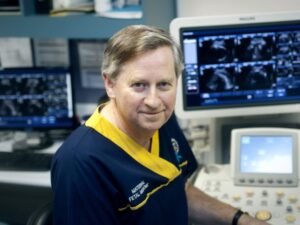
When Professor John Newnham started a campaign to stop deliveries between 37 and 39 weeks without medical indication, his obstetric colleagues were concerned.
After all, pregnancies lasting 37 weeks were regarded as term.
Early inductions or caesarean sections were considered low risk and could be timed for convenience.
“However, the idea that full term is 37 weeks was never based on any evidence,” Professor Newnham tells AusDoc.
“It was plucked out of the air in Finland in the late 1800s.”
By the mid-2010s, one in three Australian babies was born between 37 and 39 weeks.
For Professor Newnham — head of the University of WA’s division of obstetrics and gynaecology — the consequences were hiding in plain sight.
He says Australian and international data confirm that being born in the early-term window, from 37 weeks to 38 weeks and six days, significantly increases the risk of behavioural and learning problems in primary school, especially ADHD.
“But the education department lived in its world, and we lived in ours,” he says.
Change is born
By 2014, Professor Newnham was leading a WA initiative to prevent preterm and early-term births.
Within two years, it had markedly reduced preterm and early-term births, with no increase in stillbirths or neonatal ICU admissions.
The program — delivered by Professor Newnham’s Australian Preterm Birth Prevention Alliance — went national four years later.
Data published in The Lancet Obstetrics, Gynaecology & Women’s Health last week confirmed its impact.
Across 59 hospitals, representing two-thirds of all births in the public system, early-term births had fallen by about 10% — 4000 fewer cases a year.
Preterm births had dropped nearly 8%, equivalent to 1300 cases a year.
“We have achieved these outcomes safely — no increase in stillbirth, no increase in ICU admissions — while changing the culture around timing of birth,” Professor Newnham says.
The program’s core premise is simple: no births before 39 weeks without medical reasons.
This rule alone has had a “massive” impact, Professor Newnham says.
The program also includes routine cervical length screening and progesterone treatment for short cervices.
“If the cervix is short, start 200mg vaginal progesterone immediately, up to 36 weeks,” Professor Newnham says.
“But it needs to start before 20 weeks, or it is too late.”
In practice, this usually means starting treatment on the day of the mid-pregnancy morphology ultrasound.
“So, pharmacies now stock emergency progesterone starter kits of vaginal progesterone,” Professor Newnham says.
“If the cervix continues to shorten, we stitch it closed.”
Winning over sceptics
When the program went national in 2018, some private hospitals were wary of disrupting scheduling, while some obstetricians worried about undermining patient autonomy.
“Some said, ‘If a woman wants a 36-week caesarean, that is her right,'” Professor Newnham says.
“But I argued she has got to be fully informed of the consequences.”
By 2021, only one private hospital had signed up: Frances Perry House in Melbourne.
However, participation spread over the next few years, growing a network of clinicians and hospitals committed to keeping babies in utero until at least 39 weeks, mainly in the public system.
Now the private sector wants in too, Professor Newnham says.
“There is zero resistance. It is more a case of, ‘Where do we sign?’”
His secret to winning over the sceptics?
“We went with the willing. That is the principle of quality change.”
Australia’s achievement has garnered international attention, particularly in the UK.
“The UK tried to change its guidelines a few years ago to try to lower its stillbirth and preterm birth rate, but it was declared in the BMJ this year that it had failed,” Professor Newnham says.
“I was invited to present to the UK House of Lords a few months ago, and they are very interested.
“But I do not think anybody could do what we have done — not easily.”
However, progress remains slow in one area.
“The rate of preterm birth in First Nations Australians is 15%, so double the national average. In parts of the NT, it is more than 20%. It is a national scandal.”
Delivering education
When thinking about his program’s success, Professor Newnham’s mind goes to the children who reach school with learning disadvantages and ADHD diagnoses from being born just a little too soon.
“What you do today in pregnancy plays out years later,” he says.
“The story does not end with the birth. It is the beginning.”
These days, the 73-year-old focuses on mentoring younger doctors and researchers.
“My job is to set up the program’s funding base for the next five years and build the next generation to get them ready to take over when I quietly slip off into the sunset.
“I am building up their CVs, setting them up for the future.”
That next generation includes midwives undertaking PhDs in maternal–fetal medicine, which makes Professor Newnham proud.
“We are breeding up some top midwives — people who will become professors themselves one day.”
And he points to The Lancet article’s author list: some 280 names, the most the journal would allow.
Professor Newnham says 300 Australian perinatal researchers and healthcare workers are involved in the program’s success.
“It is truly a world-first story, and I am incredibly grateful I have been around long enough to initiate and lead this program and stayed healthy enough to see it through.”
More information: