War crimes? MSF Australia on Gaza, Israel and the concept of neutrality
We now live in a world where the protections borne of the horrors of World War II are unravelling.
Hospitals are attacked, health workers killed, and organisations like MSF, whose existence is built on the idea of neutrality, are now operating in a space where that principle is contested.
A few weeks ago, the Supreme Court of Israel temporarily halted a ban on 37 aid organisations, including MSF, from operating inside the Gaza Strip and the West Bank.
It followed moves by the Israeli Government to suspend their permits after the groups refused to provide detailed lists of Palestinian and international staff under new registration rules.
For some time now, MSF has faced accusations — including from Israeli officials and many Jewish organisations — that its operations in Gaza both legitimise and indirectly support Hamas, a terrorist group which massacred 1200 innocent people on 7 October 2023.
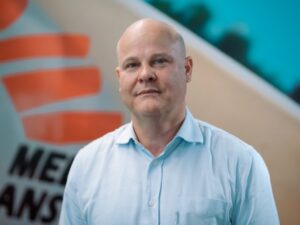
So last month, when AusDoc sat down with MSF Australia’s new chief executive, Tom Roth, the issues around Gaza were among the questions.
Why did MSF ultimately refuse to hand over a list of staff given the security threat perceived by Israel?
“I couldn’t name a place where we have provided a list of staff to an armed actor,” Mr Roth says.
Negotiations with Israeli authorities failed to produce clarity on the purpose behind holding this information, he says.
“In Palestine, medical and humanitarian workers have been intimidated, arbitrarily detained, attacked and killed by Israel. In fact, since October 2023, Israel has killed over 1,700 health workers in attacks on Gaza, including 15 of our own colleagues.
“Therefore, without the necessary assurances that safeguard our staff, MSF will not share a list of our Palestinian staff with Israeli authorities.”
But for Israel, it’s security concerns, a concern about militant groups embedded within civilian hospital infrastructure.
The fate of Al-Shifa Hospital, Gaza’s largest medical complex, is the case study.
In November 2023, Israeli forces surrounded and entered the hospital, which was sheltering thousands of patients, staff and displaced civilians from the broader conflict.
The operation unfolded amid global alarm, with images of premature babies and critically ill patients circulating as power, water and medical supplies ran critically low.
The Israel Defense Forces said the site concealed a Hamas command-and-control centre, including tunnels running beneath the complex that were being used to co-ordinate operations.
In the days that followed, the military released footage and photographs it said showed weapons stored within hospital buildings, as well as a tunnel shaft and sections of underground infrastructure uncovered nearby.
Whether true or not, given the stakes of a life-and-death struggle, surely Hamas would use hospital facilities as a cover for its operations?
Morally wrong, a breach of the Geneva Convention, but not absurd for an organisation which has committed an atrocity against Israel and its people?
What reassurance does MSF have that staff with links to terrorism are not employed?
“Any employee with links to an armed group would pose a serious risk to our staff and to our patients,” he says.
“For this reason, wherever we operate, all MSF staff are required to commit to the MSF Charter, which includes strict adherence to humanitarian principles, independence, and medical ethics.”
He says recruitment procedures include “rigorous due diligence, background and reference checks, CV verification, and probationary periods”.
Then he adds what MSF’s critics have rubbished: “Our support to the health system in Gaza is purely humanitarian and in no way ideological.”
He stresses MSF, like all aid organisations, has to negotiate access with the so-called “armed actors” to provide humanitarian care.
“Whether it’s government forces, rebel forces or other actors, first and foremost, it’s about getting an understanding that we are neutral and impartial.”
Without that dialogue, he says, there is no safe way to operate. “You put yourself at risk if you have not had those conversations.”
But MSF’s neutrality is what the Israeli Government has questioned repeatedly and for some time now.
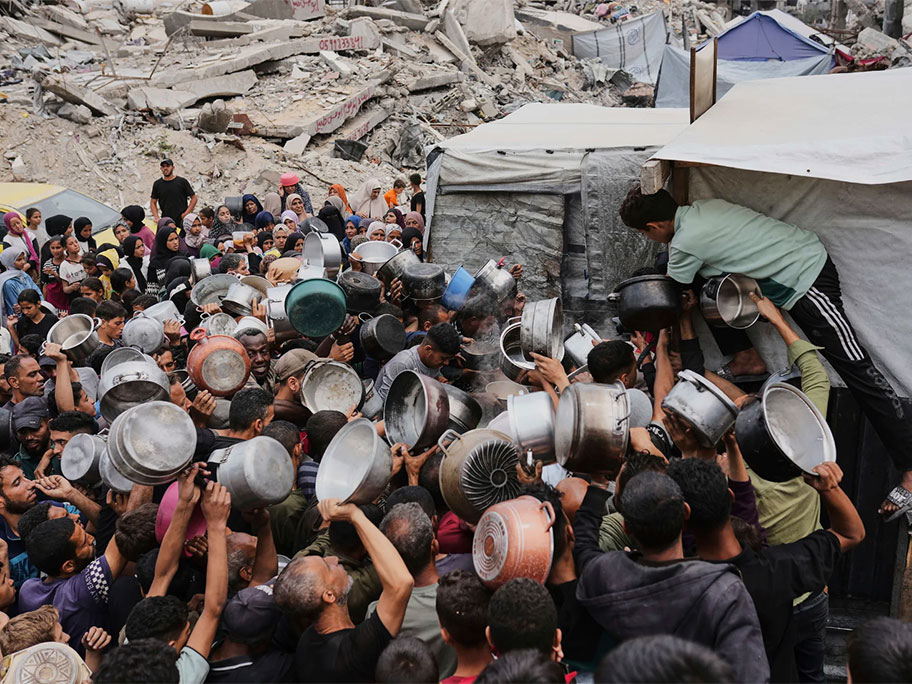
In June last year, MSF issued a press release that said Palestinians were not just being killed by bombs but also by “hunger, thirst, and the systematic destruction of the healthcare system”.
It continued: “MSF is witnessing a genocide in Gaza, as Israeli forces are responsible for mass killings, the destruction of vital civilian infrastructure, and blockades choking off access to food, water, medicines, and other essential humanitarian supplies.”
Mr Roth says MSF’s position is not about ditching its neutrality, it is about bearing witness.
“We see that in most conflicts, where we have to be constantly reinforcing what neutrality means to people. We are not siding with an armed group, we are providing medical care.”
But he says that gets more complicated when he says MSF has a mandate to talk about what it sees and experiences on the ground.
“The challenge of bearing witness, as we say in MSF, or telling it as it is, is that people perceive that in a different way.
“We are working providing medical care but also reporting when we’re being targeted or when there are blockages in humanitarian aid or we are unable to access areas, and the risk is that people will perceive that as against their interests.”
Are these political positions? He responds at first that he would not use the term ‘political’.
“We are essentially working to support civilians that need healthcare and humanitarian assistance.”
But he adds: “Is it political then to describe what it is we are seeing? I would say it is a duty on us as healthcare workers and doctors to say what is happening to our patients.
“Is it political to expect the international community to respect that hospitals shouldn’t be targeted? Okay, then we’re being political. I guess that is the challenge we have.”
Protecting humanitarian space, he says, is not targeting one or other of the armed actors.
“It’s international law and we expect all governments and the international community to stand by that.”
MSF has been condemned for what is seen as it’s relative silence around October 7 and the mass murders that took place.
Mr Roth says this: “Rightly, as with everyone else, we were shocked by the October 7 attacks and no-one would suggest at all that [what happened was] acceptable.
“It was a crime and I think it is important that all crimes are called out. That is why we have international law and norms.”
For many, the proliferation of world events, the turmoil and the horror, and US President Donald Trump’s new world order are fracturing international law, including, most importantly, the legal protections for doctors and health workers laid down by the Geneva Convention.
In 2024, some 385 humanitarian aid workers were killed across the world — 334 in 2025. In Gaza, 15 MSF staff have been killed since 2023.
For the record, the deadliest attack for MSF occurred in 2015, when a US AC-130 airstrike hit its hospital in Kunduz – 42 people dead, including 24 patients and 14 MSF staff.
Mr Roth says times have changed: “What we’re seeing is that the humanitarian space is no longer respected and across the world we are seeing the targeting of hospitals and health workers as part of the conflicts.
“This is deeply personal for me because colleagues of mine have been killed, kidnapped, and hospitals that I’ve worked in have been targeted.
“What is worse is that we’re seeing the international community often view this as a tragedy rather than a war crime.
“At the moment, put simply, it is seen as a tragedy of war, rather than what it is, which is a crime.”
For clinicians, that distinction matters, he says. It determines whether attacks are prosecuted or simply absorbed into the background noise of conflict.
And Mr Roth sees what has happened to health workers in Gaza not as an outlier, but as a signal.
“I think the Gaza conflict is emblematic in terms of how that war is being prosecuted, the restrictions and the targeting of humanitarian health workers.
“It’s not alone and we’re seeing that in other contexts we’re working in around the world.”
In his view, the erosion of consequences is contagious.
“People and governments see that there’s no consequence to their actions, so they replicate behaviours that they see elsewhere.”
Still, he insists the system is not beyond repair.
“I am an optimist … There are also possibilities to push back against some of the deterioration.”
Mr Roth also says times are such that other crises beyond Gaza, beyond Ukraine, beyond Iran are slipping from view.
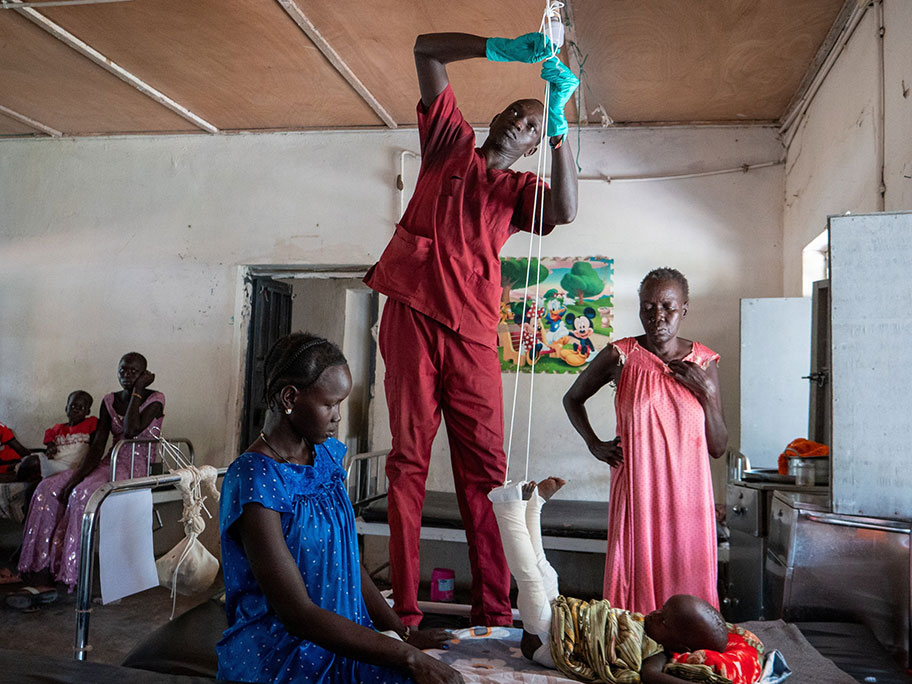
“The one that has struck me the most is Sudan … where we have been trying to address basic healthcare, including safe delivery of babies.
“I have found it challenging that we haven’t been able to get that level of recognition from the international community.
“I think people need to somehow see themselves in a conflict and maybe that is why the Middle East or Ukraine gets more coverage. Maybe they don’t see themselves in Sudan.
“Maybe it’s because there’s nothing political on offer there. These are also complicated, protracted crises.
“There are a range of reasons why the international community seem to not care, but it is something that I see as the role of MSF, is to bring that to the conscience of everybody.“
Around 30,000 MSF field staff are providing healthcare in different conflict zones around the world at any one time.
Mr Roth says he is not aware of any Jewish doctors walking away from MSF because of its position in Gaza.
“I think it is important for us to be talking to the Jewish community and making sure they understand what it is we are communicating.
“There is a difference between the Jewish community and the Israeli Government and sometimes that gets confused.
“We have plenty of people within the Jewish community who are supporting us.”
On the broader question of whether doctors and health workers worry about what it now means to provide humanitarian care in a world where “armed actors” do not abide by the Geneva Convention, he says recruitment is unaffected.
“It’s an interesting paradox in a way, we’ve seen the opposite. We’ve seen an increase in people who share that humanitarian ideal or that sense of humanity applying to work for us.
“People are concerned about what’s happening in the world and they’re stepping up and that comes in all forms.
“That’s not to say we don’t need people. We need lots of different specialties, we still have a shortage of orthopaedic surgeons, obstetric gynaecologists and reconstructive surgeons.“
For Mr Roth, the argument ultimately returns to first principles.
Strip away the politics, the accusations and the noise, and MSF’s purpose remains deliberately narrow, he claims.
For him, it exists to provide medical care in places where functioning health systems have collapsed — often in the very environments others have fled.
That work, he suggests, is not contingent on who controls the territory, but on who needs care.
Comments for this article have now been closed. Additional comments can be emailed to editor@adg.com.au.
Read more: ‘The smell of death everywhere’: Doctors and nurses return to Gaza amid a fractured peace