Pharmacist prescribing of oral contraceptives: Did the NSW premier ignored the safety warnings of his senior health officials?
If you just read the headlines, reforms across NSW to allow pharmacists to initiate, prescribe and dispense oral contraceptives have been about ending the pain and misery women face when they have to see their GP.
As Premier Chris Minns announced his grand plan back in April, he described the reform as long overdue. This was about making it easier to get care, “without extra cost or hassle”.
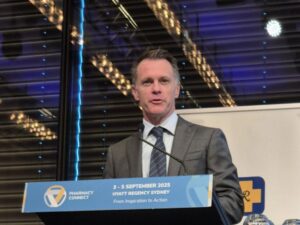
He then turned up at the Pharmacy Guild of Australia’s annual conference a few months later and, in a remarkable speech, described how much he loved the guild and promised its leaders there would be no backing down to the “vested interests”, an unsubtle reference to the doctors who were alarmed at what was happening.
As you will discover, behind the scenes, senior NSW Health officials shared the concerns, warning ministers of serious clinical safety risks and even questioning whether any evidence showed the need for the policy. It seems they were ignored.
That claim is based on a raft of documents AusDoc obtained last month under freedom of information laws.
We explicitly asked for all briefings and advice sent to the premier and the state health minister in the 12 months before the decision was announced about the clinical safety of allowing pharmacists to initiate oral contraceptives.
It took four months but the papers finally landed in our email box last month.
Many of the documents were heavily redacted, with paragraphs and pages smothered in blue and black ink.
The black, we were told, was used to censor material provided to the NSW Government in confidence by another agency, say, another department or state government.
The text beneath the blue bars was excluded because it was deemed by the FOI office to be irrelevant to our question.
Along with these redactions, a further 24 documents were withheld completely because they would reveal the “views, policy preferences, strategic considerations and recommendations” of a particular minister or contained “highly sensitive and confidential” advice prepared to inform cabinet debate.
But what survives the censor’s pen is a source of alarm and it includes the advice of Dr Kerry Chant, chief health officer and the state government’s most senior public health adviser.
One of the earliest briefings to ministers is from April 2025 when the policy was first being discussed. It begins by questioning the rationale that would ultimately be used by Mr Minns to justify the expansion of pharmacy powers.

It said that officials were already reviewing the “appropriateness of increasing community pharmacy services to include the resupply of additional hormonal contraceptive agents such as the [depot medroxyprogesterone acetate] injection and combined hormonal vaginal ring”.
But it then adds: “At this time, there is little evidence that there is a need for pharmacist initiation of hormonal contraceptive services, and there is a significant body of consultation and literature suggesting such a step may put consumers’ health at risk.”
This brief was prepared for the minister for health.
The contact name at the end of the email is Dr Natalie Klees, senior medical adviser at the office of the deputy secretary. It is signed off by Dr Chant and Dr Jan Fizzell, clinical lead in NSW Health’s division of population and public health.
In a separate NSW Health email sent by Dr Fizzell in June 2025, ministers are then told of the safety concerns documented in a TGA’s ruling from 2021, where the watchdog rejected proposals to down schedule oral contraceptive substances from S4 to S3 and allow pharmacists to supply them without a script.
Called ‘Dot points — OCP risks’, this email; too was approved by Dr Chant.
“Blood clots caused by the pill are estimated to affect around one in 1000 every year,” it reads.
It details the estimated risk of venous blood clots associated with different combined hormonal contraceptives, along with risk factors including smoking, obesity, age and a family history of thrombosis.
It also says that pharmacists’ inability to access Medicare-funded investigations to assess certain risks “poses risks to women’s health”.
Other concerns raised included missed opportunities for sexual health screening, identifying domestic violence and counselling women about long-acting reversible contraceptives such as implants and IUDs.
“Commencing women on alternatives may lead to poorer reproductive outcomes,” it continues.
It is important to stress that it does say broader training that could lead to pharmacist initiation and implantation of certain long-acting reversible contraception medications may help mitigate the risk.
Again, as per the terms of our FOI request, this is the advice which would have been given specifically to the premier and minister for health.
And it is this email which makes Mr Minns’ recent comments at the guild’s conference this year so surprising.
Defending the basis for pharmacist prescribing, he had said: “I think it’s important to say, in response to concerns that we’re approaching these changes without a scientific mindset: that’s not true.
“Our logic here is straightforward — if there’s a way to make healthcare more accessible, we will consider it.
“And if there’s clinical evidence to support the change, we will proudly lead the way in concert with our great friends from the guild.”
Brave words. But based on the FOI documents given to AusDoc, no scientific basis is given by NSW civil servants for allowing pharmacists to prescribe oral contraceptives, no journal studies cited and no independent clinical expert assessments. Perhaps there was some, but none documented by NSW officials.
Nor is there any resolution to the concerns raised in the advice. Reading through the documents we were given, all you see are the debates suddenly shifting to other topics.
For instance in the weeks following the June email, NSW Health’s advice moves to the training that pharmacists should undergo.
The big questions seem to be about the disparities between what nurse practitioners are required to do before independently prescribing oral contraceptives and the training programs then being developed for pharmacists by a number of different universities.
Dated 4 September 2025, an informal information brief for the health minister states that current models for pharmacist initiation of hormonal contraception “do not meet training comparable with other extended scope professions, such as nurse practitioners”.
It includes details of a training course proposed by Family Planning NSW, which it was argued could be used to ensure pharmacists prescribe hormonal contraception safely.
Under this proposed course, the theory component would be 100 hours long, with compulsory webinars and clinical skills workshops with role-plays. Alongside this would be a four-day clinical component done in person with direct observation at a family planning clinic of a range of patient consults.
These consults would be given by experienced doctors or nurse practitioners, who would be taking patient histories, providing clinical assessments and documenting medical notes.
The pharmacists going through this course (which would cost about $3500) would then have to pass a clinical competence assessment, and this would appear to involve — although it is not clear from the documents — some form of direct clinical supervision.
As we are about to show, these training and assessment requirements were very far from those eventually adopted.
But it was premised on concerns about the clinical training at the time being offered to pharmacists in Queensland.
The September email noted that discussions with university providers in Queensland had raised deep concerns among NSW expert advisory group members about the clinical competency of pharmacists once they completed the training.
“It was noted that pharmacists are not currently considered competent in key clinical skills upon completion of the relevant training. Instead, they are expected to self-assess and independently seek additional clinical experience to achieve the necessary level of competency,” the email states.
“This raised substantial concerns and questions about the adequacy and consistency of current training pathways.”
In terms of the documents we were sent, the chronology gets a bit murky at this point. One is dated 27 November. Sent by Dr Isis Maitland-Scott, a GP and NSW Health official, it includes an updated Contraception Care proposal. It is marked sensitive and runs to seven pages.
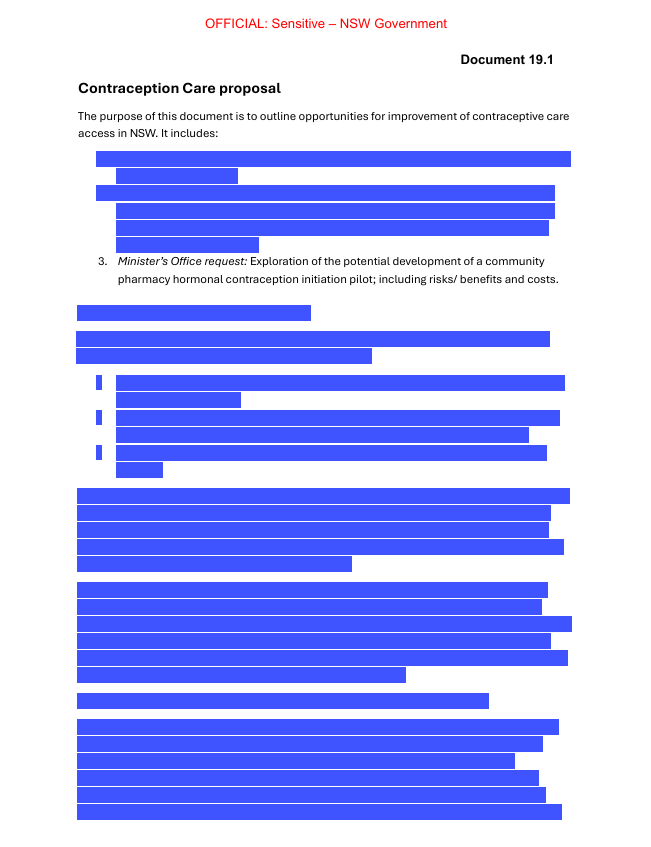
Although it sounds like a key document outlining NSW Health’s considered view, it has been obliterated by the censor’s pen. All but a few stray paragraphs survive.
It reads: “Minister’s office request: Exploration of the potential development of a community pharmacy hormonal initiation pilot, including risks/benefits and costs.”
But despite our request for all information on the clinical advice offered by NSW Health advisers, the text which follows is redacted. The colour is blue, so presumably FOI officials concluded that this was irrelevant to our request.
One uncensored sentence is worth noting: “Noting that this would have cost implications … this model may offer greater convenience for women in higher socioeconomic groups but is unlikely to address equity of access”.
It would be interesting to know the extent to which this mystery top-secret model varies from what Mr Minns subsequently announced. But it seems the benefits would be limited to women who can afford to see their GP.
So what happened with the concerns of pharmacist training?
According to the FOI documents, in March 2026, just four weeks before the policy was officially announced, Dr Chant sought detailed information from JCU’s dean of medicine and dentistry, Professor Sarah Larkins, about the university’s graduate certificate in “advanced practice and prescribing for pharmacists”.
This was the training program that was meant to equip pharmacists with the skills to prescribe for a range of conditions, from acute gastrointestinal conditions to wound care to chronic disease, including oral contraceptives.
Dr Chant asked how much teaching was dedicated to contraceptive prescribing and counselling, how many patient consultations students were directly observed undertaking and how their competence was assessed.
“NSW Health believes that practitioners providing similar services should have similar attributes, clinic experience time and assessed competencies upon graduation,” she wrote.
Several weeks later, she received a response from Professor Larkins.
“With respect to hormonal contraception specifically, this content is not taught as an isolated topic,” the GP said.
“It is embedded within a broader competency-based curriculum that addresses consultation structure, history-taking, relevant examination, clinical reasoning, communication, documentation, referral, safe and accountable prescribing, and women’s and sexual health presentations.”

She tried to assure Dr Chant that pharmacists in the program undertook ‘residential learning experiences’ during which they would receive feedback and would engage with a designated prescriber in a clinical setting.
However, she told Dr Chant that JCU was “not presently in a position to provide further disaggregated information” without a settled NSW standard against which to compare its course.
The email trail we were sent ends there, and we do not have any record of Dr Chant’s response to this message.
What we now know is that this JCU course became the pathway for pharmacists in NSW to prescribe oral contraceptives, with the premier promising to recognise at some point qualifications from University of Technology Sydney and the University of Newcastle.
AusDoc asked JCU to explain its course and what it involved. Did it include direct clinical supervision of pharmacists prescribing hormonal contraceptives? Was their clinical competency subject to assessment?
It did not directly answer the question. It offered us six paragraphs talking about the development and accreditation of the program, with assurances that it was tailored to pharmacists’ existing skills and would adequately prepare them for their expanded scope.
“JCU takes its responsibility for preparing pharmacists to practise safely and competently very seriously,” a university spokesperson wrote.
“The program incorporates clinical assessment and the application of knowledge and clinical reasoning to patient presentations, with a strong emphasis on patient safety, evidence-based decision-making and professional accountability.”
From what we can see on the JCU online handbook, the course does include a contraception module in the second trimester alongside acute gastrointestinal, musculoskeletal and ENT conditions, weight management and cardiovascular chronic disease programs.
But that seems to be it. We went back to JCU for further enlightenment. None was forthcoming. It refused to respond, saying our queries had been answered.
As we stressed earlier, the nature of the discussions at a ministerial level is unknown. We do not know the rationale for what the NSW Government rolled out. But if we have been given a complete picture of the expert clinical advice they were given by NSW officials, there seems to be no evidence that they ever suggested it should be adopted.
As things stand, pharmacists in NSW can apply for endorsement to initiate the pill after they complete the JCU course and register their intent to provide the service with NSW Health.
When the policy was announced, health minister Ryan Park said that they would also need to attend a workshop on sexual health services and referral pathways.
Family Planning NSW is developing a course with supervised clinical placements, but NSW Health has not confirmed whether it would be mandatory.
While our queries were about clinical advice, there is the politics. Many of you will be asking what was going on with the guild and the ministers. Were they meeting around this time? Wining and dining them?
Well, yes, they were.
Ministerial diaries show Mr Minns and Mr Park met with the guild repeatedly from 2023, with pharmacy prescribing and scope-of-practice reforms often listed as discussion topics.
Political donation disclosures show the guild’s NSW branch contributed $59,400 to NSW Labor in 2024/25, having also donated $1100 to Mr Minns’ Kogarah election campaign in February 2023, the year Labor was elected to government.
Mr Park had his first ‘introductory phone call’ with the guild on 6 April that year, the day after he was formally appointed NSW minister for health, and met with them again later that month.
He also attended a guild VIP dinner in August 2023 and met with representatives on 9 April 2026 — days before the pill-initiation reform was announced — to discuss pharmacist training.
One of them has spoken at the annual Pharmacy Connect conference each year since, and regular meetings with the guild have continued, with scope expansion often listed as the subject.
The guild attended the NSW Labor Business Engagement Forum and a NSW Labor Boardroom Luncheon last year, which were also attended by Mr Park and Mr Minns respectively.
One of the documents obtained by AusDoc was signed off by Dr Chant, Dr Fizzell and Dr Dunja Vekic, another Department of Health adviser, for a February 2026 meeting between Mr Park and the guild about “opportunities for community pharmacies to support more patients”.
We do not know what was discussed in detail, of course. When it comes to our FOI request, it seems the censors went into overtime.
There is a table called ‘Key issues’, and within it blue ink obliterates the text like carpet bombing.
Paragraph after paragraph was withheld; according to the justification, it was because it was not relevant to our request.
To be fair, it seems the meeting covered a range of clinical conditions, but even in the boxes titled “hormonal contraceptive resupply (expanded scope pharmacy service)”, large sections are blotted out.
All that remains is a single paragraph, promising to develop the Family Planning NSW course, at the successful completion of which pharmacists could initiate contraception.
We have lodged an appeal with FOI. It is likely to take time, but we hope that we can show the missing details.
The pharmacist rollout began in June, initially with 30 pharmacists qualified to initiate the oral contraceptive pill. The government forecast that around 250 would be qualified by the end of 2026. AusDoc requested current numbers, but NSW Health did not provide them.
NSW Health has promised there will be an evaluation of the program, but has not given a date for when it will land.
But this small-scale beginning is likely to change radically, with the Federal Government last week promising to begin funding pharmacist consults for contraception for all eligible women to the tune of $38 per consult from February next year.
It will also subsidise pharmacists’ hormonal contraceptive scripts with up to $25, at the same level as the PBS.
As we have reported at length, this policy was announced while sidestepping the usual checks and balances applied to patient safety and government spending; against the TGA’s stated position and without cost-benefit assessment of either the PBAC or the Medical Services Advisory Committee.
The new information resulting from the FOI will likely do little to allay doctors’ fears about the clinical safety risks and fragmentation of care.
But now we know these risks were repeatedly put to the men in charge by the very doctors they hired to advise them.
They cannot say they were never told by their officials tasked with providing them with independent expert advice.