Orthopaedic surgeon called in to fix baby chimp’s fractured femur
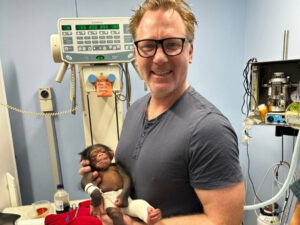
It was not even the first email that orthopaedic surgeon Dr David Wheatley had received with non-human X-rays.
His neighbour Dr Greg Muir, a vet working with Rockhampton Zoo in Queensland, had previously sent over a handful of primate X-rays, and Dr Wheatley had provided some orthopaedic advice.
This particular scan was of a chimpanzee — later named Cassie — who had fractured her femur when her mother dropped her just hours after she was born.
But this time, Dr Muir asked Dr Wheatley to personally treat the chimp.
Dr Wheatley was “only too happy to do it”.
“Of course it would make for a really good story,” he tells AusDoc.
Dr Muir administered anaesthetic while Dr Wheatley manipulated and corrected the deformity.
“Cassie had, in comparison to human anatomy, a distal femoral physeal fracture, which is unique to the paediatric or growing population, where injuries occur through the growth zones.”
Humans and chimpanzees share about 98% of their genetic material. Despite some differences, the treatment principles are similar, Dr Wheatley says.
After applying traction and repositioning the fracture, follow-up X-rays confirmed it was in a good position. The procedure took about 20 minutes.
“I put a hip spica on her, and that was it,” says Dr Wheatley, a surgeon at Mater Private Hospital Rockhampton.
After two weeks, Cassie was healing well. Dr Wheatley removed the cast and replaced it with a Robert Jones bandage for another week.
“There was so much bone, so much healing. It looked fantastic,” he says.
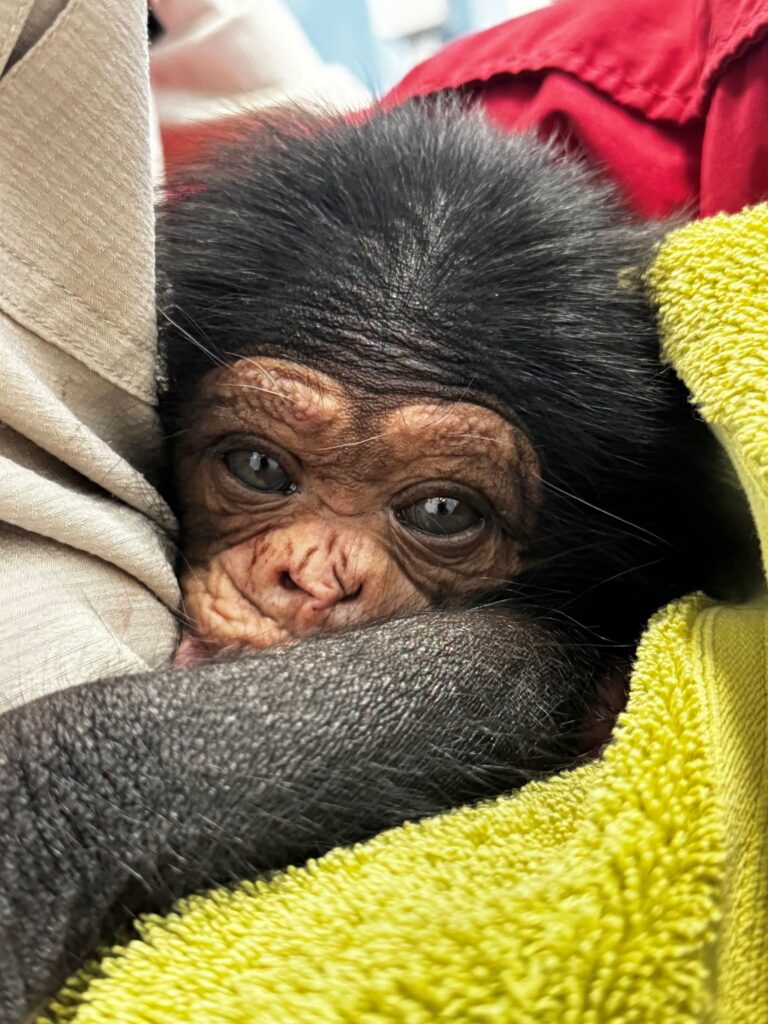
“Kids heal like wildfire anyhow. But I was told by the zookeeper that chimps heal really fast.”
During her recovery under round-the-clock care, the baby chimpanzee was fed colostrum donated by a local pregnant woman, Cassie, to supplement her formula feeds.
She was named in honour of the donor and in honour of Cassius, one of the first chimpanzees at Rockhampton Zoo.
With Cassie now aged one month, zookeepers are preparing to reintroduce her to her family and chimpanzee troop.
Dr Wheatley says the case has given him a new-found appreciation for vets, particularly in regional areas.
“There is a huge farming and grazing industry here, so there are large animal vets who do a lot of fantastic work. And then there are the regional vets within Rockhampton who do a lot of work on small animals.
“They have to be very, very versatile.”
Despite the unusual patient, Dr Wheatley says treating Cassie did not raise any indemnity concerns.