Professor John Murtagh — the AusDoc obituary
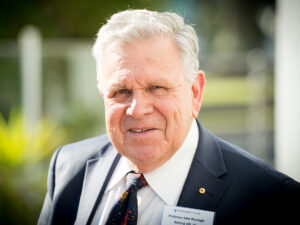
Emeritus Professor John Murtagh AO, whose eponymous textbook is considered the gold standard for GPs around the world, was once described in the pages of Australian Doctor as the JK Rowling of medical publishing.
Born in the town of Coleraine, a rich sheep-farming area in regional Victoria, he took an interest in medicine after surviving polio at the age of eight.
His diagnosis had come via the local GP, Dr Bill Tonkin, a rural doctor of the old school known for his fireside chats and sense of vocation, who would come to have a profound influence on the young Murtagh’s future life.
After toying with the idea of being a maths teacher, Professor Murtagh decided to join the first cohort of 130 medical students at Melbourne’s Monash University in 1961.
Only 29 would finish the course.
At a time when general practice was not regarded as a medical specialty, following graduation, he and his wife, Dr Jill Rosenblatt, moved to Neerim South — a town of 350 in West Gippsland — where they shared a practice for nearly 10 years and worked at the nearby 12-bed hospital.
Together, they provided a complete service: with Professor Murtagh’s skills in surgery and Dr Rosenblatt’s anaesthetics experience, they coped with most emergencies and surgical and obstetric cases.
Always known for his no-nonsense work ethic, his time as a rural GP was hugely rewarding but also demanding, where the lives and deaths of his patients could be hard.
In an interview with Australian Doctor, he once described himself as a sensitive person who did not cut off easily from others’ misfortunes.
So when Monash University approached him for a teaching job in 1979, he was ready for change.
It was at Monash that he took on the daunting task of creating the first book to capture the vast reservoirs of knowledge that the discipline demanded.
“For Dad, it was always about helping people,” said his daughter, Julie Tullberg.
“I think he was always very conscious about what it was like being a GP in the country,” she added.
“When you are isolated in the country — say, you are the only GP in the area — you do not have someone to help you, but you have got this book to guide you through any sort of problem, and that is amazing.”
The first edition of John Murtagh’s General Practice was published in 1994 and ran to more than 1500 pages.
It quickly found its place on the bookshelves of GPs across the globe, having been translated into 13 languages — from Spanish to Turkish.
One measure of its impact is that the Mandarin version became a core textbook for many of the 450,000 GPs in China: a country, like many others, trying to shift its health system away from domination by hospital specialists towards primary care.
But it was his other books, perhaps most notably Cautionary Tales, that captured his approach to medicine.
As the journalist Melissa Sweet noted: “He took after his mentor Dr Tonkin. He loves to spin a good yarn and to share his clinical experiences.
“Even to a non-doctor Cautionary Tales is a great read because it reveals its author as a keen observer, not just of the individual patient, but the human condition, with all its sorrow, joy and humour.”
On the back of his publishing successes, the honours soon followed.
He was made Officer of the Order of Australia in 1995 and awarded a fellowship with WONCA in 2007 and the AMA Gold Medal in 2018. The RACGP’s John Murtagh Library was named in his honour in 2005.
A Catholic of deep religious faith, he was also willing to speak out beyond the clinical aspects of the specialty.
In 2017, he threatened to quit the RACGP after it issued a media statement endorsing Victoria’s voluntary assisted dying laws and calling on other jurisdictions to follow suit.
There had been no member vote on the declaration.
“I do not particularly want to resign, but as a matter of principle, I might have to because this is against all the principles of good medicine; they are just sending the wrong message to patients,” he said at the time.
“We have spent so long promoting good palliative care and kindness and compassion and patient advocacy, and now, it just feels as if we are turning our backs on that.”
He also signed an open letter demanding an end to Victoria’s stage-four COVID-19 lockdowns in 2020, claiming they were causing “disproportionately enormous” harm when judged against the good being done to contain the virus.
He will be remembered for his many books but also, through his teaching, for his impact on generations of GPs — from the current Chief Medical Officer, Professor Michael Kidd, to the new generations coming through now.
Dr Anita Munoz, one of his former students and now chair of RACGP Victoria, said: “I was always amazed that, when I saw him throughout the decades, he remembered my name and expressed an interest in my journey, though I am only one of many, many hundreds of doctors he influenced over his career.
“How lucky we have all been to have had him as a champion of our profession.”
Read more: Professor John Murtagh — a doyen, a scholar and a gentleman