Dissolving minds — the violence of solitary confinement
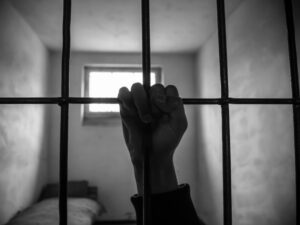
“I am the nucleus of a cube made of concrete. Six cement walls, all twins, keep me surrounded. Day in and day out.
“A tomb of solitary confinement.”
Branton Noojin is serving a 100-year sentence for murder and voluntary manslaughter in Indiana, US. Should he survive, he will be 123 years old when he sees freedom.
To date, he has spent seven years total in solitary confinement — his most recent stint the result of using a contraband mobile phone, he says.
“These concrete cubes with men inside them are designed to prevent almost all human interaction,” he writes in a testimony published online. “Still you can hear a man’s mind topple and fall.”
Under the regime, he has access to reading and writing materials. He gets one hour of exercise every five days, one phone call and three showers a week. Every other minute is spent in his concrete cell.
Rarely sleeping, he travels through time in his mind — what he describes as his only vacation from madness.
Solitary confinement, at least in its modern form, is a US invention.
Penitentiaries in the late 1820s embraced the practice as a civilising method of correction.
Prison reformers, convinced that criminality was “contagious” among convicts imprisoned together, argued that isolating a prisoner with only his conscience and his God would lead to repentance.
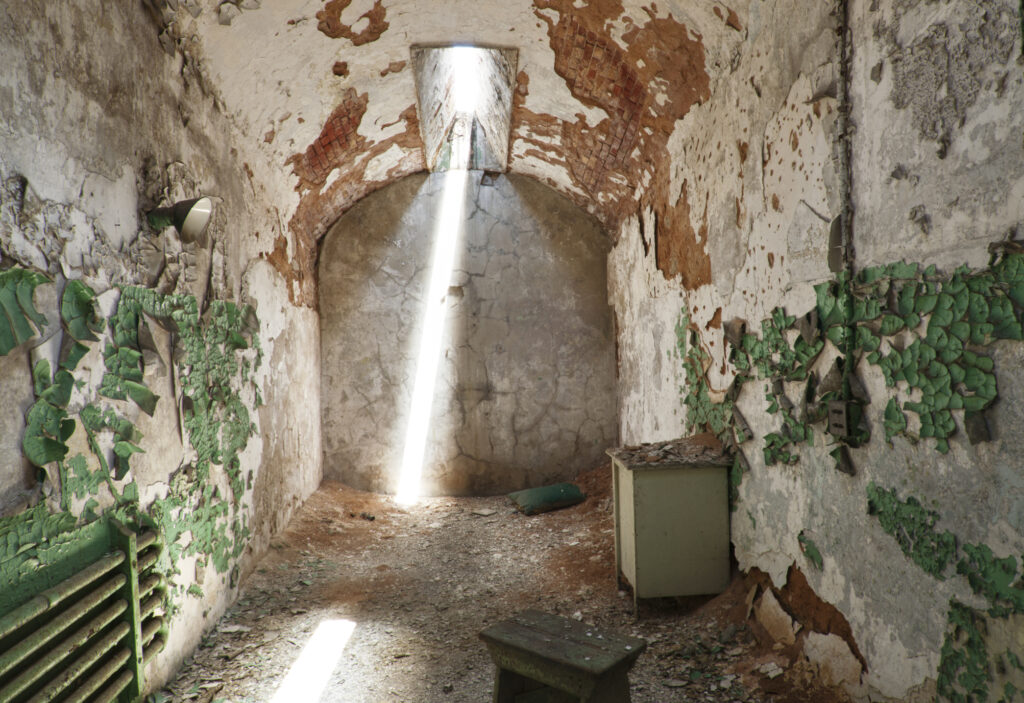
Even the architecture of these institutions carried a religious motif; each cell included a small, round skylight letting in a single beam of light — intended as mark of God’s grace perhaps.
But as these ideas spread beyond the US to Europe and Australia, concerns emerged over what isolation could do to unravel the mind.
And it’s Cherry Hill Prison in Philadelphia, the first penitentiary to adopt a complete system of solitary confinement, which began showing higher rates of death and ‘insanity’ than the other unenlightened prison regimes.
Reported mental disorders included hallucinations, dementia and monomania — the latter a 19th-century term for the obsession with a single idea or group of ideas.
By 1890, this ‘Philadelphia model’ had caught the attention of the Supreme Court of the US, where it was determined that, aside from inmates who became violently insane, survivors of solitary confinement “were not generally reformed, and in most cases did not recover sufficient mental activity to be of any subsequent service to the community”.
As a method of correction, it fell out of favour. But as a method of punishment, it persists.
It’s a technique of control that’s still common in Australia, having first been formally used in the notorious Port Arthur convict settlement, which opened its newfangled ‘Separate Prison’ in 1851, when corporal punishment and hard labour failed to have the intended reformatory effects.
But it’s a practice that psychiatrists, lawyers and prisoners argue has no place in a modern penal system.
Much of this research into the way isolation can so quickly and effectively unravel the mind came in the aftermath of World War II.
Beginning in the laboratory of psychologist Dr Donald O Hebb (PhD) at Canada’s McGill University, these studies did not attempt to replicate the real threat and punitive element.
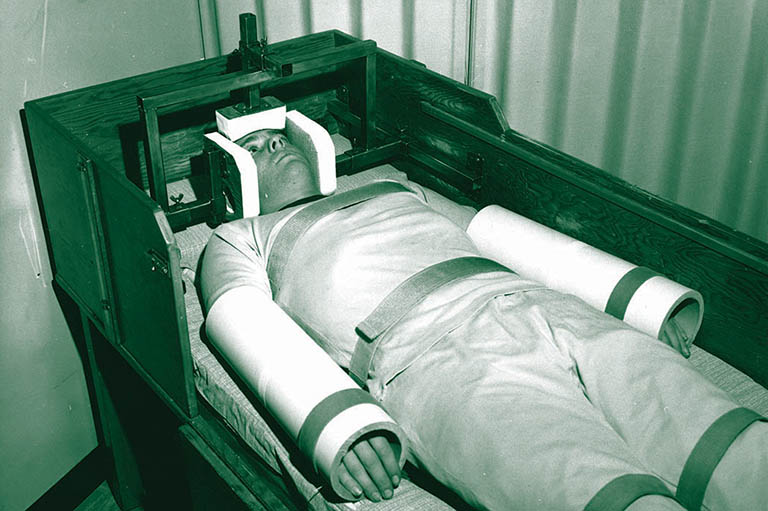
But they were intense — confining volunteers to tiny chambers, wearing goggles, headphones and cardboard over their arms to limit any sensory stimulation.
Volunteers were paid $20 to spend 24 hours a day — except for bathroom visits — reclining on a bed doing nothing. Some of them expected to be thinking about work, about revising for exams or simply using it as a rest and allowing their mind drift.
What they got were hallucinations.
Squirrels marching across the floor, prehistoric animals emerging from a jungle, the incessant chime of a music box.
The hallucinations began as amusing, but soon mutated into something more sinister, the visions becoming so intense and disturbing that they interfered with sleep.
Some volunteers started fearing a paranormal presence.
Dr Hebb found that even a few hours of social isolation was capable of producing an abnormal EEG pattern, characteristic of stupor and delirium.
The intense monotony and lack of environmental stimulation also slowed the brain’s electrical activity.
Over time, subjects become unable to focus and unable to shift their attention; at once experiencing dissociation and mental fog, but also a complete tunnel vision where even the most innocuous stimulus — a bodily sensation, a distant sound coming from another cell — becomes the object of obsession.
So while Dr Hebb initially hoped his volunteers would last several weeks, most opted out within a few days.
When it came to US research into the effects of isolation, the other trigger was the Cold War fear of brainwashing by communists.
In the aftermath of the Korean War, the US military took an interest in understanding the methods that had been applied to US airmen who had been filmed confessing to serious war crimes while held prisoner by the Chinese Government.
By 1957, it tasked social scientist Dr Albert Biderman (PhD) with interviewing the victims.
His subsequent report, called Communist Attempts to Elicit False Confessions from Air Force Prisoners of War, listed isolation as the general method number one.
“Deprives victim of all social support of his ability to resist. Develops an intense concern with self. Makes victim dependent on interrogator,” Dr Biderman noted.
In a later book on the manipulation of human behaviour, he elaborated: “[Victims] become dulled, apathetic and depressed.
“In due time, they become disoriented and confused; their memories become defective and they experience hallucinations and delusions.
“In these circumstances, their capacity for judgement and discrimination is much impaired, and they readily succumb to their need for talk and companionship; but their ability to impart accurate information may be as much impaired as their capacity to resist an interrogator.”
There is some irony then that the US embrace of the technique, which many regard as a form of torture, has been wholesale.
As we know, while Mr Noojin has been isolated, his experiences are not. The US is home to a correctional underworld with some 120,000 inmates living a daily existence in various forms of solitary confinement.
“In American prisons… the most vicious form of punishment is simply to lock a person in an empty room for years with absolutely nothing to do,” the US anthropologist and political activist David Graeber once wrote.
“This emptying of any possibility of communication or meaning is the real essence of what violence really is or does.”
Australia’s experiences, at least its modern experiences, have been less extensive.
There are currently three main supermax facilities: Goulburn’s High Risk Management Correctional Centre in NSW, Casuarina Prison’s Special Handling Unit in WA, and the Olearia unit within Barwon Prison in Victoria.
These units hold violent or insubordinate offenders, inmates convicted of terrorism charges or repeated escapees, where access to visitation rights, outdoor time, phone calls and reading material are limited.
But it is complicated.
Inmates across all Australian jurisdictions can be subjected to solitary confinement. However, the legal definition of what constitutes solitary confinement varies — and so do the reasons.
Seclusion, segregation, maximum security orders, administrative separation and separate confinement are just some of the terminologies.
Broadly, these practices all involve separating an inmate from the general prison population and confining them to a single cell, generally for at least 21 hours a day.
Most legislation outlines the use of solitary confinement for protection, safety, ‘good order’ or punishment. Typically, prison authorities will issue an order for an inmate to be subject to solitary confinement. It usually lasts for 7-14 days at a time, but this can be repeatedly extended.

“Some people have described it as a social death,” forensic psychiatrist Dr Trevor Ma told AusDoc.
Throughout his career treating patients in prisons, including at Long Bay Correctional Centre and Silverwater Correctional Centre in NSW, Dr Ma has seen inmates placed in solitary confinement experience panic attacks, dissociation, mood disturbances and hallucinations.
In extreme cases, patients have flooded their cells, smeared faeces, self-harmed or taken their own lives, he says.
All inmates held in solitary confinement are entitled to medical care, but because they cannot attend a clinic in person, Dr Ma says he has often conducted assessments through the cell-door hatch.
“There are very limited psychological strategies that are potentially effective in terms of treating these people, aside from self-help strategies, which seem to be a bit of a drop in the ocean when you see the environment that they’re being housed in,” he said.
Former inmate Cody Ward was in segregation for five months while serving a six-and-a-half-year sentence at Goulburn Correctional Centre, each day of which he spent wondering when he would get out.
“It’s pretty traumatising,” he told AusDoc.
Mr Ward’s circumstances were unique. After being threatened by other prisoners but refusing to sign into the prison’s protection service — which he described as “unsafe” — he claims he was placed in a segregated unit as a last-ditch effort from the prison at ‘protection’.
It meant he had access to amenities that other inmates in segregation lacked, such as a TV and books, and he later got to spend a few hours out of his cell working as a cleaner for the segregated unit.
But before that, he still felt like he “was losing [his] mind”.
“I remember there was one time a staff member was talking to me; he actually came to ask me about computers,” he said.
“I’m very good with computers, and he just came and asked me … about an ethernet port.
“I couldn’t for the life of me remember … I went and sat in my room afterwards, and I still couldn’t remember, and I’m like, oh my god, I’m getting dumb, what’s going on here, I’m just shutting down.
“It was sort of a profound thing … like my mind’s just slipping.”
In segregation, Mr Ward stopped exercising and writing letters to his family. He says his skin became pale, he could not sleep, and his hands were constantly itching and bleeding from untreated dermatitis.
“I’d probably spend most of my day just sort of lying around listening to the hubbub and action and everything going on outside,” he said.
“You just try and build a day full of routine,” he said, which meant repeatedly cleaning his cell and walking up and down it in laps.
“You almost start falling into a shell yourself.”
Mr Ward says he has spent the seven years since he last emerged from isolation “fighting against” that trauma.
“For a long time, I was very cautious,” he said.
“I didn’t trust people; I just wanted to get back to my room.
“That was probably the biggest effect of it; even once I moved on, I never got past the fact that I felt more comfortable just walking in my room on my own.”
So what about the long-term impact? Does life return, does the mind heal?
While the acute effects of isolation tend to subside once a person reintegrates into society, symptoms of post-traumatic stress can persist in the long term, wrote Dr Stuart Grassian, a leading Harvard University psychiatrist who first grouped the symptoms of solitary confinement into a unique psychiatric syndrome.
Based on his own interviews with hundreds of isolated inmates, Dr Grassian found that victims not only had flashbacks, chronic hypervigilance and “a pervasive sense of hopelessness”, but also became lastingly intolerant of social interaction.
Multiple studies on the long-term recovery of former prisoners of war found similar impacts, even after 3-4 decades. Some survivors also reported psychosomatic symptoms like gastrointestinal disturbances and chronic headaches.
For Mr Ward, recovery has been about forgetting.
“I’ve repressed it for the most part, to be honest. It’s not until I started talking about it that I started remembering how f***ed it all was,” Mr Ward said.
It took a lot for him to move on.
“I’ve done a lot of reading, I’ve done a lot of programs, I’ve done a lot of talking to get past it,” he said.
“But I can see how you could easily not come back from it.”
Read more: