Special report: Mark Butler and his attack on specialist fees

Mark Butler’s declaration that he would “test the boundaries” of the constitution to cap specialist fees has revived an old spectre for the medical profession: civil conscription.
That prohibition means the government cannot force its civilians to perform labour for it.
In medical mythology, the line in the sand over government meddling in the profession dates back to the 1940s, when three doctors launched a successful challenge in the High Court of Australia to the introduction of the PBS, fearing it was the beginning of nationalised healthcare (see box below).
So, one of the key questions in the current debate is whether a cap on specialist fees amounts to civil conscription.
Professor Luke Beck, a constitutional lawyer at Melbourne’s Monash University, says no.
“The [constitutional social services] provision includes power to make laws providing for ‘medical and dental services (but not so as to authorise any form of civil conscription),’” he said.
“Obviously, regulating prices is a different thing to civil conscription in the sense of forcing doctors to be employees of a government health service.
“I think that’s unlikely to run afoul of the constitution.”
This is not just speculation. He refers to High Court decisions of the past, in which control of the profession was seen as distinct from forced employment.
For example, in a 2009 decision, the High Court ruled that mandating doctors follow professional standards as a condition of Medicare registration did not breach the prohibition on civil conscription.
“The doctors were free to choose whether or not to work as doctors and, if so, where they would work,” Professor Beck says.
He also pointed out that specialist fees were already regulated by law in some ways.
Doctors are not allowed to conspire with their competitors to fix prices under the Competition and Consumer Act, or act as a cartel in other ways.
“I’m not aware of anyone suggesting those laws are unconstitutional,” Professor Beck says.
He also notes that other professions are already subject to fee caps.
In Victoria, for example, lawyers’ fees must be deemed “fair and reasonable” by the Legal Services Board and Commissioner, and some legal services have legislated caps specifying the precise amount lawyers can charge for things like affidavits.
So what are the options for doctors’ fees?
Could the government come up with new laws listing medical services with a mandate that no individual doctor can charge above a set fee?
None of the experts we interviewed for this article suggested that would happen.
But Professor Beck did suggest that Parliament could impose an income tax surcharge on non-compliant specialists or get the states to legislate to regulate fees — a route he said may avoid some constitutional issues.
The former chair of the ACCC, Professor Allan Fels, said a tax surcharge was possible but unlikely, given how politically unpopular it would be.
“The government is exempt from the competition and consumer law itself,” he told AusDoc. “If it wants to do something collectively, it can do it.
“But that doesn’t mean that there’s any chance that any Parliament would pass some laws, for example, penalising through income tax for not doing something.
“That’s never been adopted for far worse abuses. There’s no income tax penalty for murder,” he quips.
But there are other sticks that can be applied.
The government could set caps on fees which, if ignored by specialists, result in their patients being denied Medicare funding to pay for their care.
In theory, doctors are free to charge what they want, but they then face a market disadvantage given the out-of-pocket costs patients could face if stripped of Medicare subsidies.
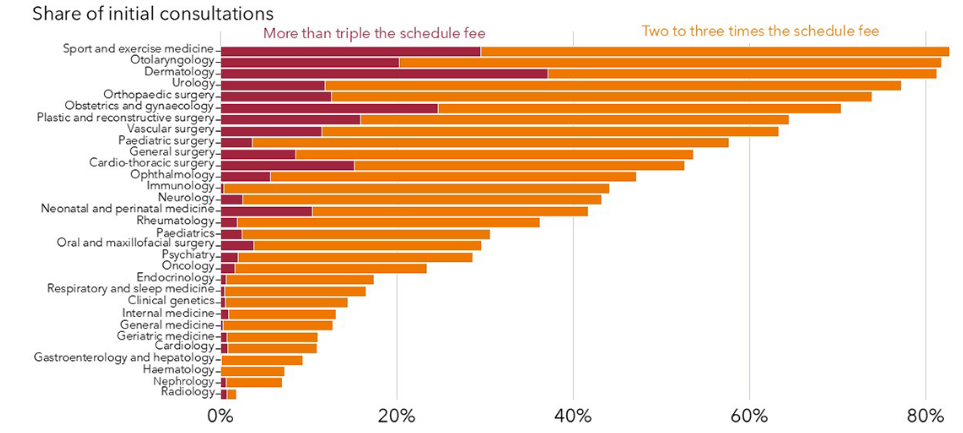
This is a version of the policy suggested by the Grattan Institute last year. It said doctors charging “excessive” fees – those it said were charging more than three times the schedule MBS fee – should repay the value of the Medicare rebates they received over the year.
It is important to make clear the impact. It said according to the data, some 4% of non-GP specialists habitually charge over three times the schedule fee.
This would mean less than 1500 doctors across 29 specialties would be affected by its detailed master plan.
The hardest hit specialities would be dermatology, O&G, and sport and exercise medicine, where more than a fifth of practitioners are charging beyond the suggested threshold for initial consults.
Mr Butler says he wants to “kick the tyres” on the idea, however, and he has already flagged some of the complications.
In a radio interview on the ABC last month, he acknowledged that some specialists — particularly those in regional and rural areas with limited competition — could opt out of Medicare, with patients having limited ability to “shop” elsewhere.
“We need to be careful not to do that in a way that, effectively, you see part of the profession opt out of Medicare so that all they’re doing is charging out-of-pocket fees with no ability to get government support there.”
He also took a notable dig at the medical colleges: “If there was good market competition and good regulation, you could prevent that. But there are also some parts of the country where there’s just not enough competition in the system because colleges control the number of new specialists coming into the system as well.”
Professor Anthony Scott, from Monash University’s Centre for Health Economics, also doubts much could be done about these specialists.
“I think if there were caps, some doctors would continue to charge above the cap if it wasn’t illegal, and those services would be fully private, and they would probably be services that are provided to quite rich people anyway. So the government may care less about that.”
The other question here is how the government would fix any cap.
The Grattan Institute says three times the schedule fee.
But can the government pull out any figure it wants — say, for a colonoscopy? It would have a vested interest in lowballing those fees.
Professor Scott says it could create an independent pricing authority, which would consult stakeholders and determine what constituted “fair and reasonable” caps.
This could be similar to the Independent Health and Aged Care Pricing Authority, which sets the national efficient price for public hospitals and aged care.
You suspect that the idea of a doctor fee authority, particularly in the absence of an independent authority that also determines “fair and reasonable” Medicare rebates, would create toxicities for say the AMA or the more politically active medical colleges like the RACGP.
Could they publicly back such a thing without doctors seeing it as a betrayal of the profession and its right to self determination?
For Professor Scott, there are other issues. A pricing authority — if it was to be created — would have relatively easy access to the costs faced by doctors to run their practices, along with the costs of things like medical indemnity and registration.
“But how do you value the doctor’s time? That will be the contentious element,” he says.
This is a tacit reference to that long, detailed and pained debate back in the 1990s about the relative value of different specialties and the need for the MBS to be restructured to reward consultative and preventive care rather than the procedures with machines that go ping.
No-one could agree, the politics turned to kryptonite and the hoped for reforms were buried in a big hole somewhere in Canberra, never to be revisited.
Professor Scott also doubts that any government would want to assess roughly 6000 MBS items individually to determine a fair cap for each. The easier option is again the Grattan Institute’s suggestion that the cap is set at some multiple of the schedule fee.
But one less discussed issue raised by Professor Scott is that reform would could alter one of the fundamental non-relationships between doctors and government.
“Medicare rebates are designed to subsidise patients’ out-of-pocket costs and there’s actually no direct relationship between doctors and the government — that’s part of the constitution, that doctors can’t be conscripted,” he said.
So Professor Scott says if reform does come, it could mean profound changes in the “nature of that contractual relationship” between doctors and government.
“Whether that might involve money going directly from the government to doctors without going via patients, that would change the nature of things a bit, I think.”
As for now, despite the noises Mr Butler has been making about a “barbecue stopper” issue, we remain in a state of political limbo.
Given that any controls on specialist fees are likely to end up being challenged in court, the question is whether the minister is ready to take on the medical profession with some form of direct action against doctors he clearly considers greedy.
| Civil conscription — a brief history |
| In 1944, the Curtin Government legislated the first iteration of the PBS, to help bring antibiotics to those who could not afford them. The Medical Society of Victoria opposed the introduction of the PBS in the High Court in 1945, arguing that there was no constitutional provision that explicitly allowed the Federal Government to make that kind of law. The High Court agreed. So, the government held a referendum, asking the people of Australia whether the constitution should be amended to allow it to provide health and social welfare services, as long as doing so did not amount to civil conscription. “The whole purpose of social services is to ensure that people may live out their lives in freedom from fear and from want,” the official Yes case argued. “The Commonwealth has not had assured constitutional power to make a just and all-embracing law for social security. “Part of such a law must be provision for health, because health is the basis of happy living.” Some 54% of people agreed it should, allowing the government to reintroduce the PBS, and paving the way for Medibank and Medicare in the future. |
Read more: Make specialists charging ‘extreme fees’ pay back the Medicare rebates, Grattan Institute says