Meet the Aussie emergency physician who writes the Emmy award-winning drama ‘The Pitt’
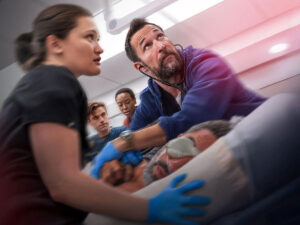
There have been Dr Kildare, ER, Grey’s Anatomy, All Saints, Scrubs and House — TV shows that with varying degrees of success have attempted to capture something of the living and breathing realities of medicine.
But few have triggered among doctors the discomfort of recognition as The Pitt.
“It took me four months to watch because I kept pausing mid-episode, knowing I might cry,” Dr Sarah Whitelaw, an emergency physician in Melbourne, recently wrote.
“I viscerally felt the familiar vigilance required for potentially critically ill and dying patients stuck in waiting rooms, lined up in corridors or ramped in ambulances, and the pressure to find space where none exists.”
What you may not know is that the realism of The Pitt, the US TV drama that screens on HBO, is due in large part to an Australian ED physician called Dr Mel Herbert. He is one of the main scriptwriters on the show.
Born in Tooleybuc, population 150, in southern NSW, his story as a dyslexic kid from rural Australia who ended up in Hollywood is probably worthy of a series of its own.
“I couldn’t even write when I was a child,” he tells AusDoc.
“I couldn’t spell at all to the point where a number of my primary school teachers were saying, ‘We think there’s something wrong with you.’
“This was 50 years ago, and the implication was that it was because you’re stupid.
“And it really wasn’t until I got to a high school that the attitude changed.
“My English teacher said, ‘You’ve got dyslexia — I see you try and spell a word, you spell it differently every time, it’s all jumbled up.’
“They said, ‘You are very articulate, but when you try to write, you’re like a third grader.'”
Dr Herbert says as a result, one of the hardest things he ever faced was getting into medicine because getting a good score in English felt impossible.
“But I made it. I wrote all the time and I memorised the words I wanted to use and I ended up at Monash University [in Melbourne].”
And this is where the plot twists come.
Back then, in the 1980s, medical students at Monash University could take a gap year to study a bachelor of medical science.
He accepted an offer to work for NASA at UCLA on a physiology study to prevent muscle loss during weightlessness.
The findings were no revolution.
Yes, resistance exercise is the key, just like it is on planet Earth.
“But it was while over there that I did what my mother said don’t do. I married an American,” he says.
He returned with his new wife to Australia to finish his medical studies before heading back to the US, where he did his residency in emergency medicine, later becoming a member of the UCLA faculty.
By 2001, he had set up the EM:RAP platform, which he says grew into an “empire” delivering CPD around the world through podcasts.
“I put the success of it down to great timing,” Dr Herbert says.
“I came to the States at a time when Australians were really popular, and I had an accent that made me sound smart.”
It was the podcast which brought him to the attention of a doctor working in Hollywood called Dr Joe Sachs, a doctor who also had a film school degree.
“This was the time when ER was just starting and they were having difficulties with the fact that it wasn’t very realistic.”
So they asked him to come on to the show and be a medical writer and consultant — an opportunity he jumped at as it sounded “fun”.
“A number of years later, Joe asked me to act as a consultant.”
Dr Herbert stayed until the end of ER in 2009.
In the aftermath the actor who played Dr John Carter, Noah Wyle, was being approached by emergency doctors hoping for a new version of life in ED, but one reflecting the darker realities of emergency medicine in the 2020s.
And that was where The Pitt — the nickname for the fictional Pittsburgh Trauma Medical Centre — was born.
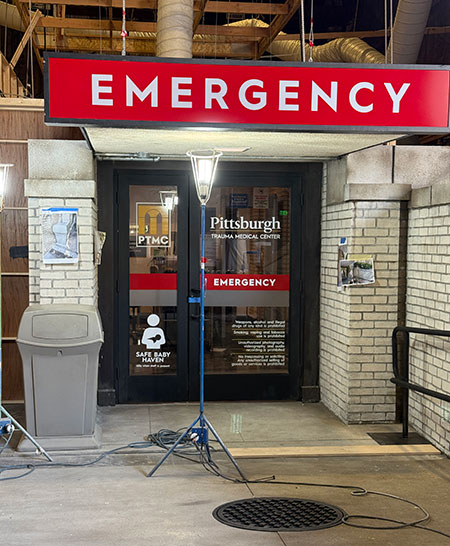
Initially brought on as a consultant, Dr Herbert was asked to come on board as a full-time writer — there are eight in total.
He didn’t quit clinical practice. He had already retired from the ED — with the exception of one month each year in Kenya with the charitable arm of his continuing education business.
“Emergency medicine is very intense, it’s shift work and the cognitive load is enormous as you have to make so many decisions quickly,” Dr Herbert says.
“Although there are ER doctors who can practise into their 70s, most of us will retire in their 50s and do something different — urgent care, telemedicine or just go to the beach.
“It’s a young person’s sport.”
For those who have not seen the show, The Pitt is (deliberately) different to its many predecessors.
The 15-episode season covers just one shift at the fictional hospital, with each episode an hour of that shift.
“We think about each character and where we want them to go for the season — their storyline of their life — and then we put the medicine in there to highlight those stories,” Dr Herbert explains.
“But then, we’re very, very clear that this show has a very powerful public health message.”
And this is where the realism kicks in.
So one of the issues tackled by the show that never confronted George Clooney for any extended period is ED bed block.
In one recent episode, a psychiatric patient dubbed ‘the Kraken’ is being held in the behavioural room due a psychiatric bed shortage.
When he awakes as a result of a commotion in the ED, the doctors face the question of forcibly sedating him with midazolam, largely because the demands of their job mean they need to be elsewhere.
As they grab him — legs, arms and head — he starts to urinate.
Later, this psychiatric patient — his name is Michael — asks to see one of the doctors and he talks about his life, the meth addiction, the fact that he has been clean for a year, that he is not taking his antipsychotics, that he is between housing right now, that he is living in an encampment on Liberty Avenue.
And yes, this is the US: he is not taking his meds because meds cost money and he does not have insurance.
“Bed blocking wasn’t a thing when ER was on,” Dr Herbert says.
The Pitt also delves into the health damage inflicted on healthcare workers themselves while doing their day (and night-shift) jobs.
“There are a lot of docs and nurses who have PTSD from COVID but also just the job itself; no-one has really talked about that before our show.
“We got Dr Robby [the main character played by Mr Wyle] to have a complete meltdown to show what that looks like and try to be as realistic as possible.
“I suffered furious PTSD at the end of my career. Many ER doctors do.
“And when you stop is the only time it hits you after all these years.
“A lot of the stories involve PTSD.”
The hope, Dr Herbert says, is that real patients in the real world gain insight as to why you often wait when arriving in ED and why now is “not the time to punch somebody in the head”.
Despite the show not being pretty or always flattering to the medical profession, the feedback from doctors has been overwhelmingly positive, he says.
At the American College of Emergency Physicians’ meeting in September — attended by 9000 doctors — Dr Herbert, Dr Sachs and Mr Wyle sat on a panel to discuss The Pitt.
“We were mobbed by people saying, ‘Please keep doing this, please keep telling the stories. My family understands what I do for the first time.’
“The thing we keep hearing over and over again is, ‘I feel seen for the first time in my career.’”
Doctors have also been impressed by the way procedures are depicted.
“We had a surgeon … who asked, ‘How did you get around the privacy laws with all of this patient footage you are using on the show?’
“There was no footage — we mock it up with art and visual effects.”
He admits there is one area which remains a work in progress.
“We get told that the CPR doesn’t look very real, but the patients are obviously real actors, so you can’t push down because you can start an arrhythmia or break their ribs.
“We are trying to work on a way to make it more realistic. It drives us all a bit crazy.”
Importantly, The Pitt has given the doctors working on the show a platform to tackle what Dr Herbert describes as “anti-expertise” sentiment.
“You’re sick and you’re dying and you come to the ER, but you don’t want to listen to what the docs or the nurses have to say … then you get angry, and you say you want your ivermectin or whatever,” he says.
“We say that, it doesn’t work, we’re not giving you that.
“And then you become outraged.
“It’s such a bizarre paradox to me, and that’s quite a moral injury for the people working in those conditions.”
So, The Pitt includes an episode with an unvaccinated teen brought in with possible acute disseminated encephalomyelitis from measles.
For his mother, there is no new dawn breaking in her mind that her decisions have led her son to this place as she ‘researches’ on her phone what the doctors are telling her.
She objects to a spinal tap being performed for a definitive diagnosis, because she has just read the procedure could cause paralysis.
At one point, Dr Robby tells her to put her “damn phone away” before giving it to her straight.
“Your son is critically ill. The longer that we wait, the higher the risk of permanent brain damage,” he says. “What is not clear here?”
Dr Herbert admits that tackling anti-vaccination can be cathartic.
“We wanted to highlight what that looks like when you make these terrible decisions,” Dr Herbert says.
“Somebody asked me, ‘If you could have anybody in the world come to the set, who would have come?’
“My answer was the US Health Secretary, Robert F Kennedy Jr.
“Seriously, I would love him to come and see what we do, look at the stories and try [to] explain to him what is really happening in the house of medicine and what vaccines do and the diseases they prevent.”
Another prominent storyline was a mass shooting at a music festival to show “as graphically as possible” how that looks when the victims arrive at the ED.
“We interviewed doctors who have been in that situation, who have been there when 20 gunshot patients came in at the same time just to show how terrible it is,” Dr Herbert says.
“What kind of society puts up with that? I think it’s because society doesn’t really know it, they don’t see.
“People talk about it all the time now — so it’s been very powerful.”
As part of the mission to remain realistic, before filming starts, he says the actors attend a boot camp to familiarise themselves with suturing, ultrasound machines and airway management.
As a result, Mr Wyle apparently has solid suturing skills, and Dr Herbert is confident that in real life “he could sew you up very nicely”.
Given Dr Herbert’s Australian roots, is there going to be a storyline inspired by the Erin Patterson mushroom murders?
Or is the case too unrealistic to be real?
“Her name has come up a lot,” he says.
“We were waiting to see how it played out in the courts — maybe her conviction was a mistake, maybe she is not a murderer, or maybe we’ll never know.
“But she can be sure she is on our minds.”
Read more: Brutal truths — as an emergency physician, I can barely watch ‘The Pitt’