The AusDoc interview: Mark Butler on his mass bulk-billing mission
With Saturday marking D-day for Mark Butler’s mass bulk-billing mission, we are bearing witness to the political alchemy that results when two divergent world views collide.
Yes, we apparently have a policy delivering a profound social good, sold as free GP care for nearly all. And then there is that alternate reality, where it is seen as a mechanism for cheap medicine — with the government laying a heavy, controlling hand on the specialty and its practitioners.
This explains the visceral reaction in some quarters to the government’s demand that any practice seeking to claim the 12.5% Medicare loading for universal bulk-billing must brand itself as a Medicare bulk-billing practice.
Many of you may already know this, but the department has revealed the mandatory signage designs.
Under the rules, it will need to be visible to the naked eye from 10 metres, it will need to direct patients through the entrance of the practice, and it will need to remain unobstructed by “any other signage or items”.
Some of the more ideological doctor groups have been speaking darkly about “mechanisms of nationalisation”.
I mentioned this to Mr Butler during a phone interview yesterday.
He said he was bewildered as to why anyone would object.
“Medicare, and we’ve seen this time and time again, is the most trusted government brand in the country. Why any doctor would want to distance him or herself from it is a mystery to me,” he said.
“I’ve never had a conversation with a doctor who has said they don’t want to be associated with the Medicare brand.
“When we tied the Medicare brand to health services, we found the trust from the community lifted.”
He pointed to the Medicare Mental Health Centres as examples.
“It made clear the services were free on a walk-in basis, without a referral. Activity in those centres climbed dramatically because people finally got the essence of it.
“So no, you’re not going to get an apology from me about banging the Medicare brand drum. It’s our best brand, not as the Labor Party, it’s our best brand as a Federal Government.”
The debate about what happens after 1 November has been running for some time now.
Mr Butler argues it is not complicated: it is a money calculation.
The government’s claim during the federal election was that the number of practices universally bulk-billing would increase from 1600 to around 4800 by 2030.
The minister says this was simply based on the modelling identifying the practices that would be better off bulk-billing.
But given the variety of worthy uses to which health dollars can be put, why put $7.9 billion in incentives towards bulk-billing non-concessional patients?
I read him a quote from an open letter written by Dr Max Mollenkopf, the GP practice owner in Newcastle, NSW who is attracting a following on social media.
“When you pour in billions of dollars into incentives to bulk-bill incidental care for my middle- and upper-class patients, you’ve left my desperately ill patients out in the cold,” Dr Mollenkopf had said.
“I don’t agree with that,” Mr Butler responded.
“Yes, the concession card holders and kids were the focus of our first investments in 2023, and tripling the incentives has succeeded in turning around what was a decline in bulk-billing for those groups. I think the last figure I saw was 92%.
“But one of the very deliberate focus points of our Medicare and PBS policies are people who don’t qualify for concession cards. As you know, the concession card kicks out, from memory, at around $40,000 a year for a single. So it’s not big money.”
He said data is showing that low- and middle-income cohorts were the most likely not to go to a doctor or fill a script because of cost.
“The heavy lifting we have done is for general patients because the income groups outside the concession card threshold are the ones who are really feeling the sharpest impact by what’s happening to bulk-billing,” he said.
“Now, will Gina Rinehart get bulk-billed? I don’t expect her to, and that probably applies to me too.”
For the current government, amid a cost-of-living crisis, everything seems linked to bulk-billing — at least when it comes to GPs. With other specialists it’s more hands off. But for the moment it seems any future big investment in general practice is going will include a demand to bulk-bill.
He baulks at that.
But the AMA and the RACGP calls for increases in rebates — is that now a fantasy? Putting $5 on a level B is never going to happen?
“We’ve unapologetically said that the bulk of our investment will be focused on turning bulk-billing around. The medical groups effectively said, when we were developing the investment, ‘Just give us the money in Medicare rebates increases and trust us.’
“That’s not a decision we’re going to take. If we’re going to put more money into Medicare, particularly into primary care, which I’ve said for my entire time as health minister is my number one focus, then we expect an outcome for patients in terms of affordability.”
I mention the national media coverage surrounding the plight of Cohealth, the community health service in Melbourne trying to support 12,500 vulnerable patients — those living on the streets, the refugees, the people with serious drug and alcohol issues. Even with the bulk-billing investments, it is still struggling with $4 million in deficits.
As a result, next month it will wind up its GP services — a case study of the patients Dr Mollenkopf says are being left out in the cold.
The deeper point, however, is that it a case study in the failure of fee-for-service, which Mr Butler came into office pledging to fix.
Back in 2022, he was chairing the GP task force charting the geography of the promised land, the MyMedicare reforms, which would use voluntary patient registration as a means to fund supports for complex patients floundering in the health system’s cracks.
What happened?
The ministerial media releases made noises about supporting 14,000 so-called frequent flyers circulating in and out of the hospital system. The initial money was tiny, just $99 million over four years. But the general idea was this model could slowly extend to others in aged care and mental health.
Then came silence. Did the money disappear into urgent care clinics — an easy-sell election promise?
The social cost has been significant, I suggest. A policy whose impact on lives and health budgets could have been far more profound seems lost.
“The urgent care clinic program is different and separate,” he responded.
“It is something that we become more and more convinced, as it develops deeper roots, is the right model to sit between general practice and fully equipped hospitals.
“I said in a couple of forums over the last couple of days that I would love to have been in a position after the Strengthening Medicare Taskforce to put all of our energy, time and money into reforming the way the MBS works and to move more quickly to bundled funding models, particularly for patients with complex chronic disease.
“We are building the foundations … But I do regret that we’ve had to spend as much time and money on dealing with what was really a burning platform around affordability through these big bulk-billing investments.
“If we had inherited a position that was in better shape, frankly, then we would have pushed much more heavily, more quickly into that area.
“But as I’ve said to the AMA, who are very focused on reform, it remains a focus of ours as well. We’ve just had to deal with affordability first.”
Is it just a lack of money?
“I think we’ve all experienced a frustration at how difficult it is to actually make change … There is a recognition by doctors’ groups to get on with it. I understand that, but I’ve been clear with them and unapologetic that we have had to focus on affordability.”
When it comes to the money, there is a statistic worth quoting from the RACGP’s Health of the Nation report.
It states the average per capita funding from the Australian Government for GP care in 2015 (shortly after the health system’s panto villain Peter Dutton was booted from the health portfolio after his bungled attempt to end bulk-billing forever) was $442.
In real terms, the figure in 2023/24 was $452 per capita – $10 more.
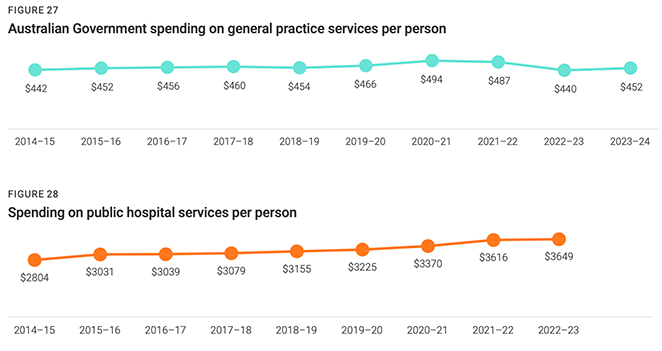
So, government investment has flatlined.
“I think you’ll find it’s more a duck curve than a flatline,” Mr Butler said.
“The Coalition often talk about what the bulk-billing rate was and what the investment was in 2014.
“Well, that was after six years of the Labor Government which had invested heavily in health.
“It was after that point that you saw something worse than a flatline; you saw a decline in real terms in investment.
“I don’t think any group, including the college, would deny that we have invested more in primary care through Medicare than any government I can remember.
“A lot of that has been catch-up, a lot of that has been addressing affordability concerns that emerged from that long rebate freeze.”
I pointed out that the rebate freeze damage was never reversed.
“The damage was stopped by your government, and everyone has welcomed that,” I told him.
“But the rebates have never been restored to the value they would’ve been had the freeze never happened.”
Mr Butler’s response: “No, we deliberately put the investment back through the prism of bulk-billing. The investment we announced during the election basically reflects what the AMA says was lost to Medicare through the rebate freeze.
“It does put that money back in, but not through a general increase to the rebate where doctors can choose either to pocket it or to pass it on to patients in better affordability.”
For my final question, I raise an issue that has not featured in the public debate, but you suspect it hovers like a dark, menacing cloud in the debates within GP practices now discussing whether to embrace Mr Butler’s bulk-billing future.
The experience of bulk-billing for many GPs 20 years ago was the six-minute sausage-machine medicine that Tony Abbott, as prime minister, tried to decry during the co-pay disaster.
“Do you worry, given the level of funding for bulk-billed consults, we’re going to return to those big corporates churning through patients for the volume rather than for the quality care?” I ask.
“I can’t see any rational reason why that would happen,” Mr Butler replies.
“The calculations, for example, that we’ve done are based on the existing business model or practice model.
“The earnings calculator that we’ve used from the sector itself is based, I think on 15-minute consults, not six-minute consults. So there’s no reason for that to happen.
“Our offer to the sector is that this investment makes you better off, or at least three-quarters of the practices better off. And that is based on no change in the time you spend with patients.”
The discussions will continue on its impact, but the Federal Government’s second big bulk-billing investment begins on Saturday.
The next 12 months should quickly determine whether Mr Butler has got his behavioural economics right.
Read more: