They told him he would fail: Meet the doctor who created a $10 billion global empire
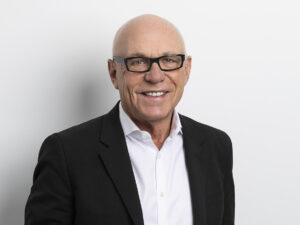
They told him he would fail.
That doctors cannot run anything.
That corporate pathology cannot work that way.
Three decades later, Dr Colin Goldschmidt has proven the naysayers wrong.
The CEO of Sonic Healthcare is about to step down, having built a $10 billion global empire from a company newly listed on the ASX whose share price, at one point, had sunk to less than 10 cents.
“Perhaps we might be allowed to say that our model not only works but presents a compelling case in favour of a medically led management structure for any healthcare organisation,” the pathologist tells AusDoc.
He says he never intended to become a CEO. There was no singular vision. He chose medicine for altruistic reasons.
By the late 1980s, he had completed his training as a histopathologist at Royal Prince Alfred Hospital in Sydney.
Against the conventional wisdom to remain working in the public hospital system, he took a job at a small private pathology practice called Douglass Laboratories — later known as Douglass Hanly Moir.
There he was one of three employed pathologists when the loss-making pathology laboratory was sold to a newly listed public company called Sonic Healthcare.
Sonic’s bottom line was struggling, he says, but he was content to stay put.
He had endured the “tough years” of making it as a specialist, and he found his clinical work fulfilling.
Yet whether he liked it or not, change was happening, and he was set to be the central player.
The unravelling of Sonic
Fast forward to 1992, Sonic’s financial woes eventually led to the sacking of the incumbent CEO, triggering mass resignations by senior management.
With the share price falling below the 10-cent mark, an unknown engineer from Perth called Barry Patterson announced he was planning a takeover of the business, but, as he told Dr Goldschmidt, “I know nothing about pathology”.
He added: “I’m an engineer who believes that engineers should run engineering businesses and pathologists should run pathology businesses.”
So, Dr Goldschmidt, then a 38-year-old with no corporate experience, agreed to take charge.
“I accepted the role as a reluctant, inexperienced new CEO.
“Business management was nowhere in my career plans, nor did I have any formal business training.”
The immediate goal was simply to save the practice, he says. But very early on, he says he adopted the term “medical leadership” to define Sonic’s approach and management style.
“I would say without reservation that medical leadership is the secret sauce of Sonic Healthcare.”
But not everyone was impressed.
Dr Goldschmidt recalls several prominent healthcare figures telling him it would fail.
This was back in the early ’90s, when Australian pathology was a highly fragmented cottage industry, and small labs lacked the scale to secure their futures.
It meant that Sonic had a competitive advantage — relatively easy access to bank and equity capital.
And so began Sonic Healthcare’s acquisition journey, something that The Australian Financial Review (AFR) would later dub the Pac-Man approach, as it gobbled up its rivals.
There was even a strategy and internal unit dubbed the Sonic Amalgamation Team to ensure the synergies worked, according to the AFR.
This led to industry consolidation and then, under Dr Goldschmidt’s leadership, an expansion overseas to New Zealand, the UK, Germany, the US, Switzerland and Belgium.
He says while other corporations stripped out the local identity and autonomy of their acquisitions, he maintained laboratory names and allowed clinicians to run them.
A global footprint with local DNA
Today, Sonic’s red-and-blue double-helix logo can be found in cities around the world — from Sullivan Nicolaides Pathology in Brisbane to The Doctors Laboratory in London and Clinical Pathology Laboratories in Austin, Texas.
Yet none of these entities bears the name Sonic Healthcare.
“We decided early on to retain the trade names of the labs we acquired,” Dr Goldschmidt says.
“It was about respecting the goodwill built over time.”
There has been diversification, not least in Sonic Healthcare and IPN, the GP corporate, where Sonic moved to majority ownership in 2005.
But pathology remains the primary focus, making up 85% of its total revenue, with three-quarters of that coming from overseas operations.
The numbers capture the financial impact. The company is worth some $10 billion with a net profit of $514 million.
It has also meant that Dr Goldschmidt, someone who has remained wary of the public eye, is a big-name CEO. He sits 16th on the list of highest-paid CEOs at ASX-listed companies.
Throughout his corporate career, he maintained his medical registration as a specialist pathologist and continued to do his CPD as a practising doctor.
For all the success stories (Dr Ed Bateman creating the Primary Health Care empire, Dr Sam Prince, a billionaire who founded the Mexican restaurant chain Zambrero, and Dr Dennis Bastas, who built Arrotex Pharmaceuticals), doctors and business are not meant to mix well.
Dr Goldschmidt advises doctors considering a corporate role to express their interest in leadership and then apply for open positions by highlighting the benefits of medical leadership.
“The many Sonic doctors who have made the transition to management have slotted in easily, particularly because they possess such a deep understanding of the businesses they are running.
“The financial management skills required for these roles have been easily learned and have not been a barrier to their success. As you can tell, I feel strongly that healthcare systems in general would benefit enormously if there were more medical leaders in the top management roles.”
Did he ever think he would sink, ever think he had bitten off more than he could chew?
“While there were moments of fear of failure, the desire to succeed was more pervasive for me,” he says.
A career that comes full circle
After 32 years as CEO, Dr Goldschmidt will step down next month, having laid claim to being the oldest and longest-tenured CEO in the S&P/ASX 50.
Limelight has been something he seems never to have sought. He is known more for politely declining interviews, even with the AFR.
He says his successor, Dr Jim Newcombe — who runs Douglass Hanly Moir Pathology — is also a pathologist and infectious diseases physician, a deliberate continuation of the model Dr Goldschmidt built.
But he says it is time for him to find new passions and slow the pace, spending time with family, travelling and playing lots of golf and bridge.
For this reluctant corporate icon, it closes a chapter that began with low expectations and ended with one of Australia’s biggest corporate success stories.