How Dr Pawel Kuterba went from cop to doctor: ‘To care for someone who has done wrong is gracious’
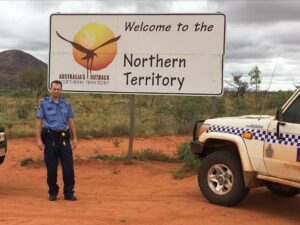
There was a part of policing that made Dr Pawel Kuterba feel uncomfortable.
“It requires a level of assertiveness and always being on your toes when you work, because not everyone likes the police.
“You often rock up to jobs, and when people see the uniform, they are on their back foot straightaway without even having known you.
“None of that really agreed with me.”
Yet for so many years, a move to medicine seemed like a pipedream.
Dr Kuterba’s first exposure to the medical world was during his early 20s, when he moved from Poland to the UK to chase a career as a musician.
Between gigs and teaching music, he started providing music therapy to mental health patients in forensic hospitals.
“I did that for about two years in a heavy security inpatient ward.
“It was my first time rubbing shoulders with psychiatrists and occupational therapists and seeing those interactions with patients.”
The experience stuck with him, yet he dismissed the idea of becoming a doctor as something that was “never going to happen”.
“I knew my limitations. I didn’t have the financial stability or the educational background.”
Instead, he became a police officer, hoping for more job security than what music provided.
After five years, the opportunity to transfer to Australia arose.
“I wasn’t tied to the UK in any meaningful way at that point, so I took the adventure.”
He landed in WA, policing some of its most remote communities.
“Working in a small community, you work closely with doctors and hospitals.
“Some hospitals only had a three-bed ED, so you always saw the same people.
“You build professional relationships, and you see how the doctors work. That was always something I would pay attention to.”
As a police officer, his provision of medical care was mainly basic first aid, wound care and transporting victims of crime, or criminals, to hospital.
“The five minutes you spent performing CPR while waiting for the ambulance always felt like five hours,” he says.
“Then you would hear the sweet sound of the sirens.”
He found it rewarding to provide care to people who had committed a crime.
“It felt like an equaliser.
“Obviously, it was my job to show care to someone who has done something wrong, but it is actually a gracious and kind thing to do.
“It felt good to say, ‘You still deserve to be treated well.’”
In his first year on the beat in WA, someone took their own life in front of him after he arrived at the scene.
He avoids going into detail to protect those involved but says he remembers feeling “helpless — like I wasn’t able to do anything”.
The experience left him wanting to better understand why people struggle.
“A lot of people in the police fear the jobs where someone is in some kind of crisis, where there is no real crime being committed, but more, ‘We’re worried because someone is walking down the side of the road screaming at themselves.’
“I was always the one to say, ‘I want to go.’”
In 2015, he enrolled in a counterterrorism degree, hoping it would pave his way to sit the Graduate Medical School Admissions Test (GAMSAT).
“There were days I would plan to write my assignments, then end up doing a 15- or 18-hour workday.
“When you work in a community of 800 people and two police officers are covering 300km, if something happens, you’re it.
“You get the phone call at midnight, put on your uniform and go to work.”
On his second GAMSAT attempt, he secured his place at medical school.
“I got into Wollongong because they favoured rural people with life experiences and they wanted me.
“But I knew I would accept a place regardless of where it was.”
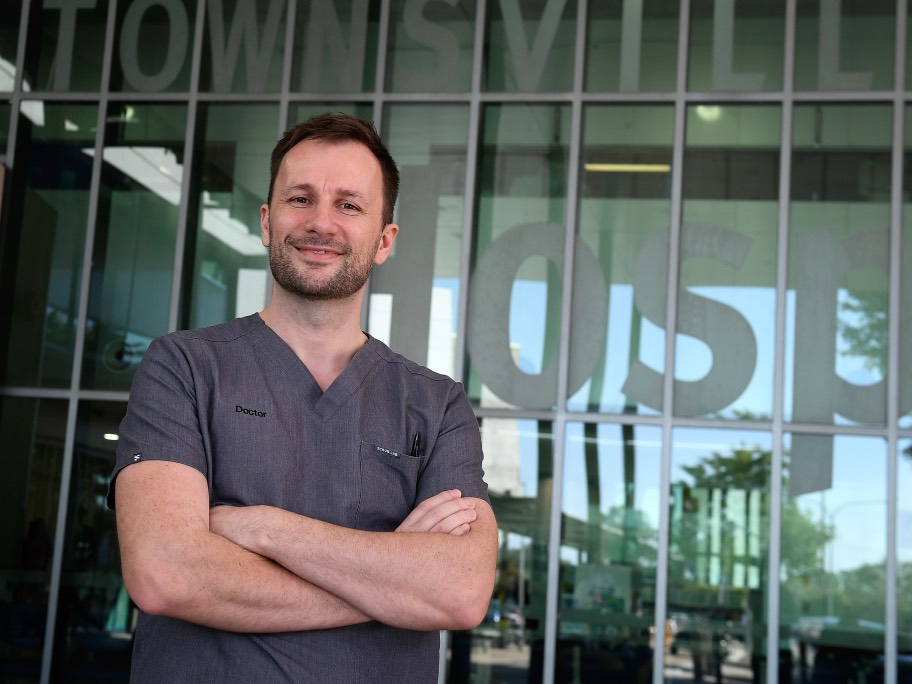
On 1 January 2022, in his late 30s, he quit policing after 12 years.
“It was a massive leap of faith.
“It has been challenging going into a career where everyone is younger than you and you’re back to square one when you’ve been used to having more decision-making ability.”
In hospitals, Dr Kuterba says death feels more predictable — “you can often predict the trajectory a case is heading in” — but it still affects you in the same way.
Mental health crises are more contained but “no less chaotic”.
“The emotions that people are going through are as raw as they would be on the streets,” he says.
“But your role is different. As a police officer, you have certain powers to contain someone’s behaviour, but as a doctor you don’t in the same way.”
He says policing has made him more “resistant” to pressure in medicine.
“Policing has a lot of pressures, paperwork and court documentation.
“Everything is scrutinised. Someone will always find a flaw with the decisions you make.
“Working under a crazy amount of pressure in medicine, whether the acuteness of the illness or the workload, I have been able to be unfazed by that.
“I find it a bit easier to think on my feet in stressful situations when the wheels are falling off.”
He is also well equipped to manage difficult patients.
“In medicine, you sometimes arrive at situations where people are in pain or have unanswered questions or are not having their needs met, and they’re angry.
“As a police officer, you deal with people who are upset or intoxicated daily. You get used to managing that.
“You learn that people get angry because they are in distress.
“Having that perspective, knowing that there is a reason why, has been useful in medicine.”
Now eight months into working at Townsville University Hospital in Queensland, Dr Kuterba hopes to pursue rural psychiatry in the future.
“When I did my psychiatry rotation, I would receive people from the police officers, and I knew what they would have had to encounter.
“When you come across someone with first-episode psychosis, they don’t know what’s happening and often police officers don’t know either.
“That was always a curiosity for me. I think it is why I see psychiatry on the horizon.”
The experiences of his police colleagues are also motivators.
“I’ve had colleagues with PTSD and colleagues who have taken their lives.
“Seeing that side of psychiatry, where you have people who you know have gone through trauma, and trying to manage that, was fascinating.
“I felt that having the policing experience and being able to apply it in a psychiatric context could help to bridge some gaps in communication.”
Nowadays, when he goes into work, those he meets are less likely to be on the back foot.
“There is space to introduce your personality as a doctor.
“The assumed role when you show up isn’t that you are there to cause harm or victimise someone.
“It is that you are there to help them.”
Read more:
- ‘Jail isn’t like what you see on Netflix’: GP turned top prison doctor
- GP turned forensic investigator: ‘If you own every trauma you see, you would drown under the weight’
If this article has raised issues for you or you are concerned about someone you know, the following support services are available 24 hours a day, seven days a week. In an emergency, call triple zero:
- Lifeline: 13 11 14
- Beyond Blue: 1300 224 636
- Suicide Call Back Service: 1300 659 467
State- and territory-based doctors’ health services:
- ACT: 1300 374 377
- NSW: 02 9437 6552
- NT: 08 8366 0250
- Queensland: 07 3833 4352
- SA: 08 8366 0250
- Tasmania: 1300 374 377
- Victoria: 1300 330 543
- WA: 08 6388 4904
Mental health support line (telepsychology):
- Drs4Drs: 1300 374 377