Perfectionism and health professionals

This article has been allocated 0.5 EA by the RACGP and ACRRM for the 2026-2028 triennium.
You can self-report this CPD/PDP activity by logging it online with the RACGP and ACRRM. Click on the link for RACGP Quick Log or go to your ACRRM page.
Need to know:
- Perfectionism is self-worth based on high standards despite negative effects.
- It is common in doctors and other health professionals.
- Perfectionism is linked to burnout, anxiety and depression.
- CBT for perfectionism has been widely studied and is effective.
- Free online programs based on CBT for perfectionism are available.
Helpful strategies include aiming to increase relaxation time away from work and recognising and reducing self-criticism.
Perfectionism is a commonly used term, but what does it mean as a doctor or health professional?
Striving for high standards and excellence are not inherently negative.
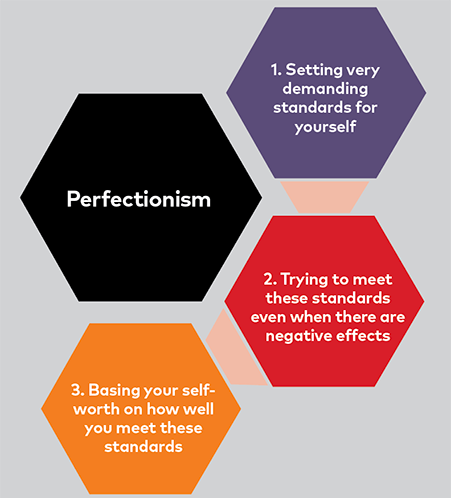
Perfectionism is different from simply aiming for excellence. It becomes a problem when self-worth is based on meeting standards, despite negative effects.1
Unchecked perfectionism can become maladaptive, characterised by unrealistic standards, self-criticism and an inability to accept one’s own best efforts.
This can have a range of adverse mental health consequences, increasing the risk of anxiety, depression and burnout in medical professionals.2
- This is part two of a series — read part one Strategies for tackling perfectionism here.
| Resources: |
Questionnaires and evidence-based CBT for perfectionism: • WA Department of Health — Centre for Clinical Interventions CBT for perfectionism: • overcomingperfectionism.com |
The three key elements of perfectionism are illustrated in figure 1.
How does perfectionism impact doctors?
When striving for high standards is also accompanied by self-criticism, ruminating over mistakes, and all-or-nothing thinking, it can be linked to burnout, poorer mental health and mental illness.2
Examples of all-or-nothing thinking include statements such as “I only got 75% in the exam, it was not a high distinction, therefore I am a complete failure” or “I should never miss anything my patients say about their symptoms, I am a failure if I do.”
Perfectionism is linked to burnout, anxiety, depression and eating disorders.3,4,5 This is as true for health professionals as it is for the general population. Self-critical aspects of perfectionism predict burnout in doctors.6,7 In a review of perfectionism and mental health in medicine, higher perfectionism was found to be associated with a greater risk of burnout, anxiety and depression.8
Treatment options
There are a range of evidence-based psychological therapies to help overcome perfectionism. The most widely studied and effective is CBT for perfectionism.9-11 Most studies on CBT for perfectionism have evaluated it as a self-help program, including delivery online and as a traditional hard copy self-help book.11
CBT for perfectionism has been evaluated in over 15 randomised controlled trials. It is effective in preventing the onset and symptoms of anxiety, depression and eating disorders associated with perfectionism.9-11
It involves teaching the participant that they are worth more as a person than just their achievements at work (or other valued areas of their life).12 CBT for perfectionism involves learning strategies to decrease self-criticism and rumination over mistakes and challenging all-or-nothing or thinking.12 CBT techniques include behavioural experiments to challenge unhelpful thinking, fostering self-compassion, and increasing rest time and enjoyable activities.12
How to overcome perfectionism?
Reflect on your own perfectionism
Think about whether you feel bad about yourself when you do not meet a goal. Are you continually setting high standards for yourself that are hard to reach? Reflect on whether you are procrastinating over some tasks, even though you feel bad about this later.
Are you spending a lot of time ruminating over mistakes you have made? Another key aspect of perfectionism is downplaying your successes. For example, when you achieve your goals, are you likely to think ‘that was no big deal, others in my cohort also achieved this endpoint’? Or continue to set your goals higher?
Online tools can help clinicians do a quick check of their own levels of perfectionism (see resources).
It is not about lower standards
CBT for perfectionism is not about trying to reduce standards or stop striving to achieve. Instead, it is about trying strategies to test what happens when striving is approached in a different way. It is about learning you are good enough as a person, and that self-worth is about more than just achievement of goals.
Balancing striving with rest and enjoyment
It is tempting and easy, especially when busy, to let go of recommendations you would give to patients to promote their wellbeing. It is important to have downtime, sleep, spend time doing enjoyable activities, and spend time with family and friends.
A recent study which assessed treatment approaches delivered to medical trainees for managing perfectionism suggested doing a cost–benefit analysis of perfectionism. This involves weighing the pros and cons and reflecting on how a lack of exercise or sleep (as examples) affects the participants’ work, wellbeing and family.2 Consider whether you include enough enjoyable activities in your week to reduce burnout and achieve more balance.
Experiment with your perfectionism
Behavioural experiments are a useful way to change perfectionism. It can be a surprise to learn that by challenging beliefs about striving, wellbeing improves and performance either stays the same or improves. Excessive striving combined with self-criticism, is more likely to lead to exhaustion and burnout, resulting in poorer performance.
Think about a perfectionistic prediction. For example, a thought such as ‘I must stay up most of the night preparing for my specialist exam.’ To test this out, two different behavioural experiments can be conducted. For experiment 1, the exam is undertaken after engaging in the usual perfectionistic preparation, which includes little sleep.
In the next exam, experiment 2 could involve preparing to study over a set time, then going to bed at a normal bedtime to ensure adequate sleep. Next, scores on both exams and mood are rated and compared. Conclusions can then be drawn about which approach led to better performance and wellbeing.
Increase self-compassion
A key tool to reduce self-criticism is learning to foster self-compassion (see box 1).
| Box 1. So how do you become more self-compassionate? Try these three steps |
1. Identify your self-critical thoughts. Are there any thoughts you have about yourself that you would hesitate to say to another person? (eg, ‘that was hopeless’ or ‘you were not good enough’). 2. Think about the costs of self-criticism. Reflect and write down any negative costs of self-criticism such as exhaustion and stress. Think about whether you are practising double standards and treating yourself differently from others. Do you have one set of harsher rules for yourself? (eg, ‘it is okay if others make mistakes, but I must never make a mistake’). 3. Practice self-compassion and apply values you use with friends to yourself. Reflect on the values you apply to your friends. This might include treating others with courtesy, respect, acceptance, caring and forgiveness. Now think about applying these values to yourself. Ask yourself ‘what would a compassionate response be?’ Think about responding to your own mistakes the way that you would give advice to a friend (eg, ‘you cannot get it right all the time, you are trying your best’). |
Self-compassion refers to being kind to oneself in times of difficulty. Lower self-compassion is linked to greater likelihood of symptoms of poor mental health.13,14 Self-compassion may have a protective role on the association between perfectionism and burnout in medicine and dentistry students.15
Which coach do you want to be?
Another useful way to overcome self-criticism is to think about the types of coach a child may have. Consider a child who wants to learn basketball. They have two coaches. Coach A berates the child every time they drop the ball, saying ‘you should try harder, your performance is not up to scratch’. Coach B on the other hand is encouraging. When the child makes a mistake Coach B gives messages like, ‘it is okay, making mistakes is an important part of learning’. Coach B thinks about other ways to approach the problem and does not get hung up on self-blame.
Now think, if that child was someone you cared about, which coach would you prefer them to learn from? Most people want Coach B, the encouraging coach. But consider what coach you are to yourself. Are you Coach A, giving yourself a hard time for mistakes?
Which coach would get a better performance and improve wellbeing in the child? Now consider which coach would bring out a better performance and wellbeing for you? Think about ways to practise being Coach B to yourself. Notice times you are being self-critical and challenge and replace these thoughts with more helpful and encouraging thoughts. Treat yourself the way you would treat a friend, rather than being the harsh, critical coach.
Conclusions
Perfectionism is common in doctors and health professionals. Reflecting on your own experience of perfectionism, and potential strategies to ameliorate its adverse effects, can be helpful not only for your own wellbeing but also for your care of other health professionals and patients.
Read more by Professor Egan: Strategies for tackling perfectionism
Professor Sarah Egan is an academic clinical psychologist at the school of population health and the enAble Institute, Curtin University, Perth, WA.
Conflict of interest statement: The author receives royalties for the books Overcoming Perfectionism: A self-help guide using scientifically supported cognitive behavioural techniques, second edition, and Cognitive-Behavioral Treatment of Perfectionism.
Self-report this CPD/PDP activity by logging it online with the RACGP and ACRRM. Click on the link for RACGP Quick Log or go to your ACRRM page.


- References on request from Dr Kate Kelso.