$15 a minute? Bulk-billing changes rewarding ‘sausage machine’ medicine
GPs warning that the Federal Government’s budget billions for bulk-billing is creating incentives for so-called sausage-machine medicine now have numbers to back it up.
A Grattan Institute analysis shows that the Medicare cash per minute is now $11 for a bulk-billed level B consultation lasting six minutes compared with $3.30 if the same consult lasts 20 minutes.
While Medicare has long rewarded churn, this $7.70 gap was bigger than the $6 gap before the tripled bulk-billing incentives were expanded from concession card holders to all patients last year.
Adding the 12.5% loading for universally bulk-billing practices widened the gap to $8.60, according to the analysis published on Wednesday.
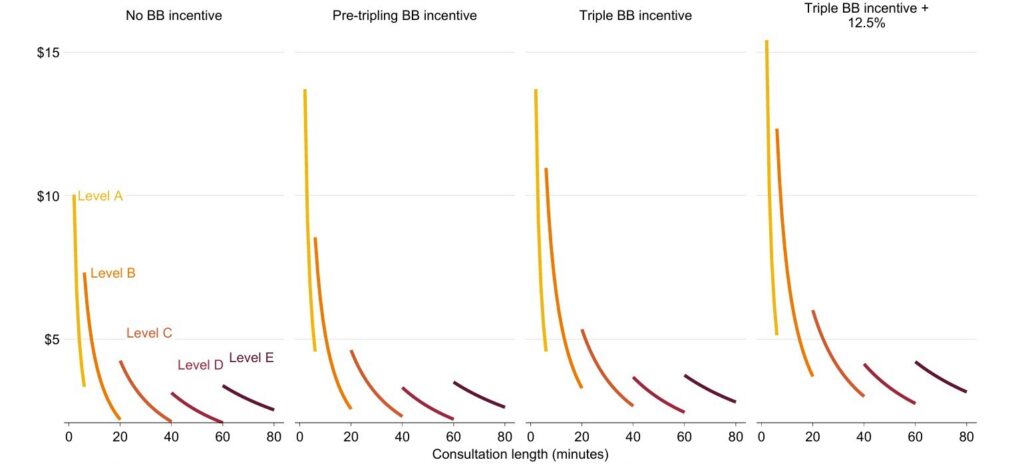
The analysis found that a two-minute consult netted $15.41 per minute, highlighting an oddity of the government’s bulk-billing changes given the urgent need for funding complex GP care.
As the data show, level A consultations do not attract the tripled bulk-billing incentives. However, they are eligible for 12.5% loading if practices offer universal bulk-billing.
“The government’s goal was to increase bulk-billing, which had been falling sharply, and the policy worked,” the analysis said.
“But the new spending has also deepened fundamental problems with how we fund GPs.
“It has strengthened incentives for GPs to have quick consultations with their patients, sent money to parts of Australia that didn’t need it, and left behind areas that need more funding the most.”
It said that bulk-billing rates had risen across all socioeconomic groups and remained highest among the most disadvantaged quintile of patients.
But in terms of the share of the bulk-billing incentive cash, the wealthiest parts of Australia had increased their share, while the most disadvantaged Australians watched their share of funding shrink, it said.
“Before November 2025, restricting the bulk-billing incentive to children and concession card holders was the closest thing mainstream GP funding had to a needs-based adjustment.
“It wasn’t much, but it did direct more money to clinics with more disadvantaged patients.
“Expanding the incentive to all patients removed that.”
Australia now had the “crudest” funding model among comparable health systems, said the authors — the institute’s health program director Peter Breadon and associate Molly Chapman.
The only remaining equity measure was remote loading, the duo concluded.
Yet it was “essentially arbitrary”.
“The levels of remoteness, such as ‘regional centre’ and ‘small town’, lump together areas with vastly different levels of wealth, health and access to care.
“For example, almost one in five regional centres are in the top quarter of the country for GP services per person.”
It called on the government to create an alternative to fee-for-service that GP practices could opt into.
This alternative would blend fee-for-service and block funding, adjusted for the age, comorbidities, wealth and rurality of a practice’s patients, it said.
“Without the right policies, healthcare always flows uphill to the wealthiest, and Australia removed one of the few ways policy shifted GP funding towards need.”
It comes at a time when the MyMedicare policy has been floundering.
The voluntary patient registration scheme was meant to provide GP practices block-funding for ‘frequent flyer’ patients and others with complex needs.
But the plug has already been pulled the funding for frequent flyers.
Health minister Mark Butler said in an interview with AusDoc last year: “ I would love to have been in a position after the Strengthening Medicare Taskforce to put all of our energy, time and money into reforming the way the MBS works and to move more quickly to bundled funding models, particularly for patients with complex chronic disease.
“We are building the foundations … But I do regret that we’ve had to spend as much time and money on dealing with what was really a burning platform around affordability through these big bulk-billing investments.”
He added: “But as I’ve said to the AMA, who are very focused on reform, it remains a focus of ours as well. We’ve just had to deal with affordability first.”
Read more: Half of GP practices now universally bulk-billing, Mark Butler says